

The Universal Pattern Theory
Diversity, Convergence, and the Recurring Structures of Intelligent Civilization

Executive Summary
For generations, humanity has debated one of the most profound questions imaginable: if intelligent life exists elsewhere in the universe, would it resemble us or would it be so fundamentally different that meaningful comparison becomes impossible? Popular culture, scientific speculation, and philosophical inquiry have often approached this question from opposing extremes. One perspective assumes that intelligent civilizations eventually become similar because reason, technology, and progress naturally guide societies toward comparable outcomes. The other assumes that extraterrestrial civilizations would be so alien in biology, culture, and psychology that human concepts would have little relevance in understanding them. The Universal Pattern Theory proposes a middle path between these competing assumptions by arguing that diversity and similarity emerge simultaneously through interacting forces that shape all intelligent societies.
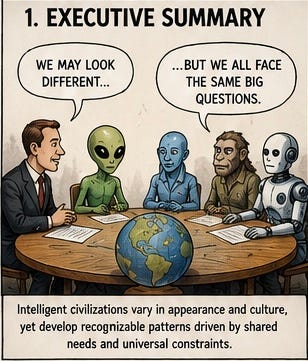
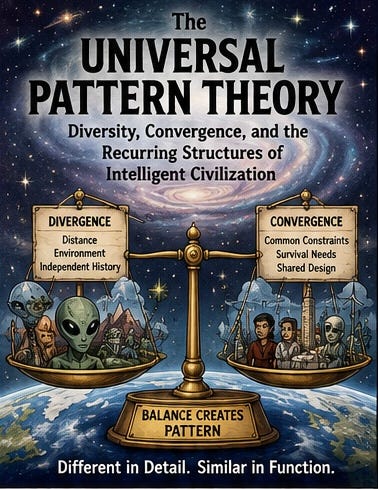
The Universal Pattern Theory states that intelligent life develops according to a dynamic balance between forces of divergence and forces of convergence. Divergence arises from environmental variation, geographical separation, historical contingency, and independent development. Convergence emerges from common physical laws, shared survival requirements, resource limitations, and potentially common design origins. The interaction of these forces produces civilizations that may appear radically different on the surface while exhibiting recognizable patterns in organization, adaptation, innovation, and collective behavior. The theory therefore rejects the assumption that intelligent life must become either identical or incomprehensibly different. Instead, it predicts a spectrum of outcomes shaped by both uniqueness and commonality.
This framework serves as a unifying model that incorporates several previously proposed concepts, including the Civilizational Distance Principle, the Common Design Principle, the Divergence Convergence Principle, and the Universal Constraint Principle. Each of these theories addresses a specific aspect of how intelligent societies evolve and interact with their environments. The Universal Pattern Theory integrates them into a broader explanatory structure capable of analyzing not only hypothetical extraterrestrial civilizations but also human societies, political institutions, economic systems, and emerging artificial intelligences. By focusing on recurring patterns rather than specific outcomes, the theory offers a framework for understanding intelligent life across a potentially vast range of conditions and circumstances.
Introduction
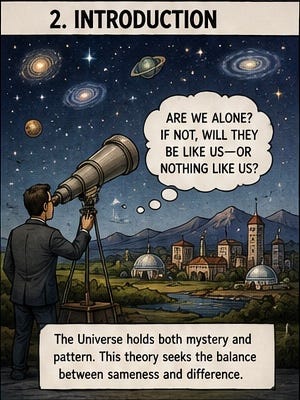
Throughout human history, the search for patterns has served as one of the primary engines of scientific and intellectual progress. Astronomy identified recurring motions among celestial bodies. Biology revealed common structures among living organisms. Political science uncovered recurring tendencies in governance, power, and social organization. In each case, complexity became understandable when observers recognized that seemingly unrelated phenomena often followed underlying patterns. The Universal Pattern Theory extends this approach beyond Earth by asking whether intelligent civilizations throughout the universe might also exhibit recurring structures despite vast differences in appearance and history.
The challenge of understanding intelligent life beyond Earth is not simply a scientific problem. It is also a philosophical, political, and strategic problem. Human beings tend to interpret the unknown through familiar assumptions. Some envision extraterrestrials as technologically advanced versions of humanity. Others imagine entities so radically different that communication, cooperation, or even recognition might be impossible. Both perspectives contain elements of plausibility, yet both risk oversimplifying the forces that shape intelligent societies. A framework capable of accounting for both similarity and difference may therefore provide a more realistic basis for future analysis.
The Universal Pattern Theory begins with the observation that intelligent systems are shaped by competing pressures. Some forces push civilizations toward uniqueness by exposing them to different environments, histories, and developmental pathways. Other forces push civilizations toward similarity because all intelligent life must solve fundamental problems associated with survival, resource acquisition, adaptation, and collective organization. These pressures do not cancel each other out. Instead, they operate simultaneously and continuously, producing a universe characterized by diversity within recurring patterns.
From a political science perspective, this framework resembles the study of comparative government and international relations. Nations throughout human history have developed different institutions, laws, cultures, and ideologies. Yet they have also confronted many of the same challenges involving security, legitimacy, economics, and social cohesion. The existence of variation does not eliminate the existence of patterns. Likewise, the existence of patterns does not eliminate meaningful differences. The Universal Pattern Theory argues that this relationship may represent a universal characteristic of intelligent civilization itself.
The Intellectual Foundations of the Theory
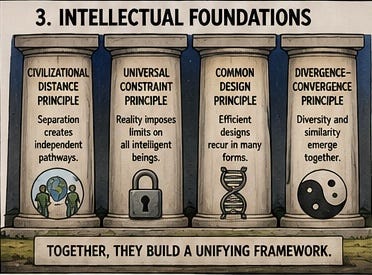
The first foundation of the Universal Pattern Theory is the recognition that intelligent systems rarely develop in isolation from environmental influences. Geography has shaped the development of human civilizations for thousands of years. Mountain ranges, deserts, rivers, oceans, and climate conditions have influenced trade networks, military strategy, economic production, and cultural exchange. Similar environmental influences would likely affect civilizations developing elsewhere in the universe. Different conditions naturally generate different outcomes, creating the diversity observed among societies and potentially among intelligent species.
A second foundation emerges from the observation that physical reality imposes limits on all actors regardless of their location. Human societies cannot ignore gravity, thermodynamics, resource scarcity, or biological requirements. These constraints narrow the range of viable choices available to individuals and institutions. The Universal Constraint Principle suggests that intelligent civilizations throughout the cosmos would face analogous limitations. While technologies may differ dramatically, the underlying need to operate within physical reality remains constant. Constraints therefore act as a stabilizing force that encourages recurring solutions to recurring problems.
The third foundation involves the possibility that recurring designs may emerge across different contexts. The Common Design Principle proposes that similar structures may appear repeatedly because they represent efficient solutions rather than random outcomes. On Earth, independent evolutionary pathways often produce analogous biological features because certain designs effectively solve particular environmental challenges. Whether one attributes these patterns to natural processes, intelligent design, or some combination of both, the existence of recurring structures suggests that not every outcome is equally probable. Some forms simply work better than others under comparable conditions.
Finally, the Divergence Convergence Principle provides the immediate mechanism through which diversity and similarity emerge simultaneously. Divergence generates variation by separating populations and exposing them to unique circumstances. Convergence generates recurring patterns by rewarding solutions that effectively address common challenges. Together these forces create a dynamic process in which civilizations continually adapt to their own environments while responding to universal realities. The Universal Pattern Theory builds upon this interaction and elevates it into a comprehensive framework for understanding intelligent life itself.
The Forces of Divergence
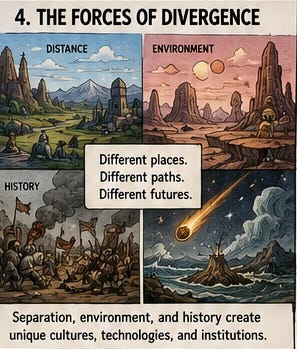
The Universal Pattern Theory begins with the recognition that diversity is not an anomaly within intelligent development. Rather, diversity is the expected outcome whenever populations experience separation, distinct environmental conditions, and independent historical trajectories. The forces that generate divergence operate continuously and often over immense periods of time. As civilizations become increasingly isolated from one another, they accumulate unique experiences that shape their institutions, technologies, cultures, and identities. This process can be observed throughout human history and may represent a universal characteristic of intelligent life. Divergence therefore serves as one of the primary engines of civilizational variation.
One of the most significant sources of divergence is physical distance. The Civilizational Distance Principle argues that as separation increases, opportunities for cultural exchange, technological transfer, and social interaction decrease. Independent development allows civilizations to experiment with different solutions to similar problems. Over centuries or millennia, these differences compound and create increasingly distinct social systems. Even among human societies sharing the same biological origins, distance has produced substantial variation in language, religion, governance, economic organization, and cultural values. On an interstellar scale, these differences could become far more pronounced.
Environmental variation further accelerates divergence by exposing societies to unique challenges and opportunities. A civilization developing on a world rich in water and biological diversity may evolve differently than one emerging on a dry planet characterized by scarce resources and harsh environmental conditions. Climate, geography, gravity, atmospheric composition, and available energy sources all influence how societies organize themselves and allocate resources. Different environments encourage different adaptations, creating alternative developmental pathways that may persist for thousands of years. The result is a universe in which diversity naturally emerges from local conditions.
Historical contingency represents another powerful source of divergence. Civilizations are shaped not only by long-term structural factors but also by unexpected events that alter their developmental trajectories. Wars, natural disasters, technological breakthroughs, political revolutions, migrations, and economic transformations all influence the direction of social evolution. Small events can generate profound consequences when their effects accumulate over time. Two civilizations with nearly identical starting conditions may ultimately develop into dramatically different societies because of a handful of critical historical moments. Divergence therefore reflects both environmental realities and the unpredictable nature of history itself.
Political institutions provide a useful example of how divergence operates. Human societies have produced monarchies, democracies, oligarchies, republics, tribal confederations, and countless hybrid systems. These forms emerged because different communities faced different challenges and possessed different historical experiences. The existence of multiple governance models demonstrates that intelligent societies are capable of pursuing numerous paths toward social organization. Universal Pattern Theory predicts that extraterrestrial civilizations may display an even wider range of institutional arrangements shaped by conditions unique to their own worlds.
The Forces of Convergence
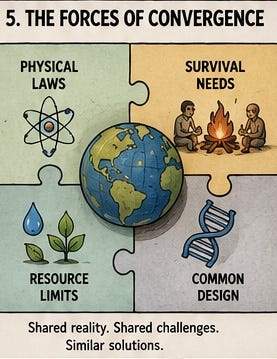
While divergence generates diversity, convergence generates recurring patterns. Convergence refers to the tendency of independent civilizations to arrive at comparable solutions when confronted with similar constraints and objectives. These patterns emerge not because societies directly imitate one another but because reality itself limits the range of viable outcomes. The Universal Pattern Theory argues that convergence is every bit as important as divergence in shaping intelligent development. Understanding convergence is essential for explaining why similarities appear across otherwise unrelated societies.
The Universal Constraint Principle provides one of the primary mechanisms driving convergence. Every intelligent civilization must operate within the boundaries imposed by physical reality. Energy must be acquired and managed. Resources must be extracted, distributed, and conserved. Populations must adapt to environmental pressures while maintaining social stability. These requirements exist regardless of culture, ideology, or biological origin. Because the challenges are similar, civilizations frequently discover comparable solutions despite developing independently.
Survival requirements also create powerful convergent pressures. Intelligent societies that fail to secure resources, coordinate collective action, or respond effectively to threats are unlikely to persist over long periods of time. Successful civilizations therefore tend to develop institutions capable of addressing these recurring challenges. The specific forms may vary considerably, but the underlying functions remain recognizable. Governments manage order, economic systems allocate resources, and social norms regulate behavior because these functions contribute to long-term survival. Convergence emerges from the practical demands of existence rather than from cultural similarity alone.
Technological development provides another illustration of convergent forces. Throughout human history, multiple societies independently invented agriculture, writing systems, architecture, metallurgy, and complex governance structures. These innovations appeared because they addressed recurring problems associated with population growth and social complexity. The timing and methods differed, yet the general direction of development displayed remarkable parallels. Universal Pattern Theory suggests that advanced civilizations elsewhere may experience comparable technological convergences even if the resulting technologies appear unfamiliar to human observers.
The Common Design Principle offers an additional explanation for recurring patterns. If life shares common origins, common design frameworks, or recurring evolutionary solutions, then certain biological and structural features may emerge repeatedly throughout the universe. Similar sensory systems, locomotion methods, or organizational structures may appear because they represent efficient responses to common challenges. Whether these patterns result from natural selection, intelligent design, or some combination of influences, their existence reinforces the broader expectation that convergence plays a central role in shaping intelligent life.
The Universal Pattern Framework
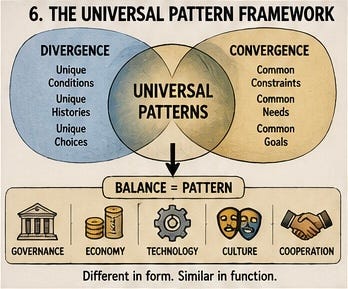
The Universal Pattern Theory achieves its explanatory power by integrating divergence and convergence into a single analytical framework. Most theories emphasize one force at the expense of the other. Some focus primarily on diversity and uniqueness, while others emphasize recurring structures and predictable outcomes. Universal Pattern Theory argues that both forces operate simultaneously and that meaningful analysis requires understanding their interaction. Intelligent civilizations are shaped not by divergence alone or convergence alone but by the continuous balance between them.
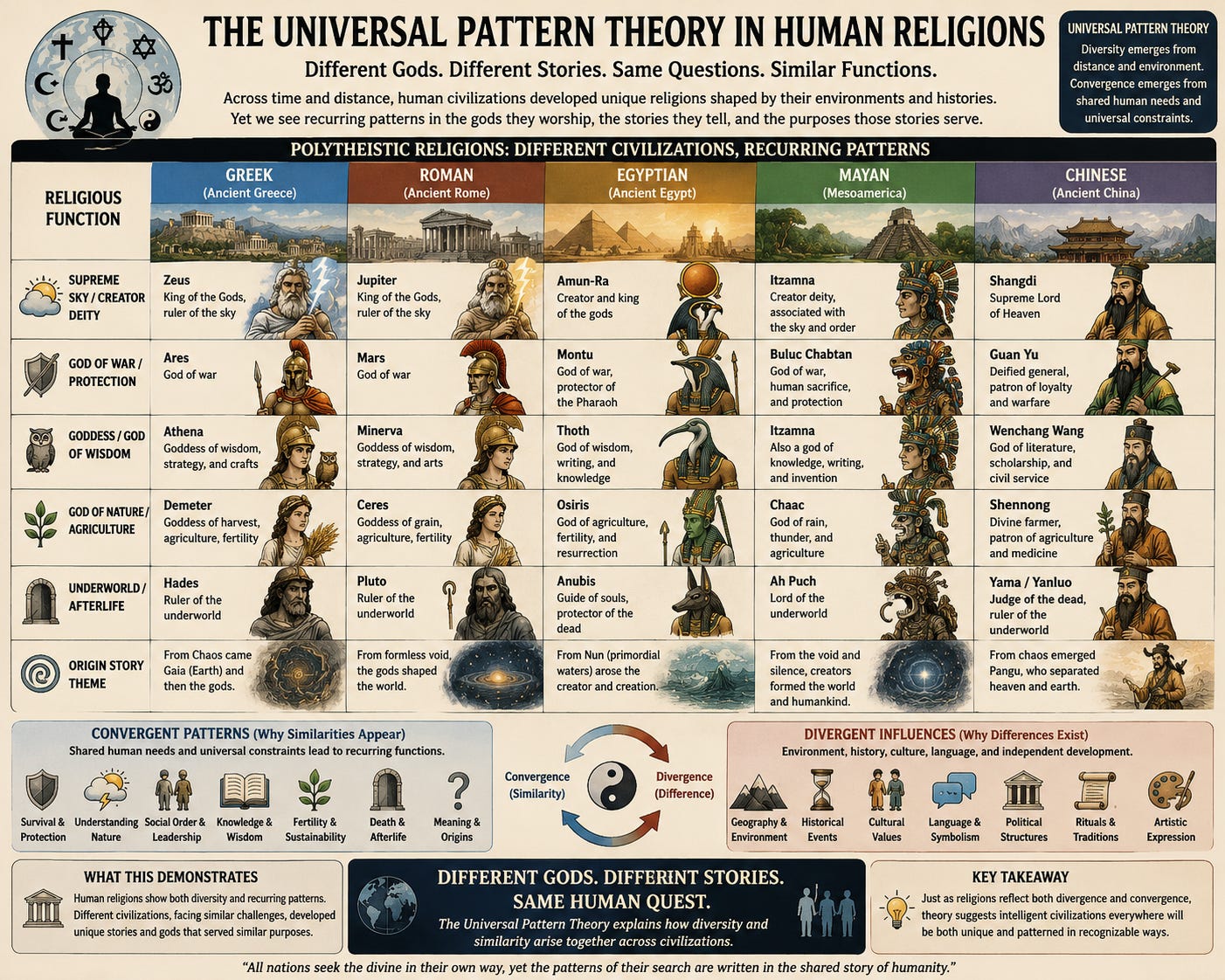
Under this framework, every civilization exists within a field of competing pressures. Environmental differences, historical experiences, and geographic separation encourage uniqueness. At the same time, physical laws, survival requirements, and recurring constraints encourage similarity. The observable characteristics of a civilization represent the cumulative result of these opposing influences. Diversity emerges because circumstances differ. Patterns emerge because reality imposes common requirements. Neither tendency completely overcomes the other.
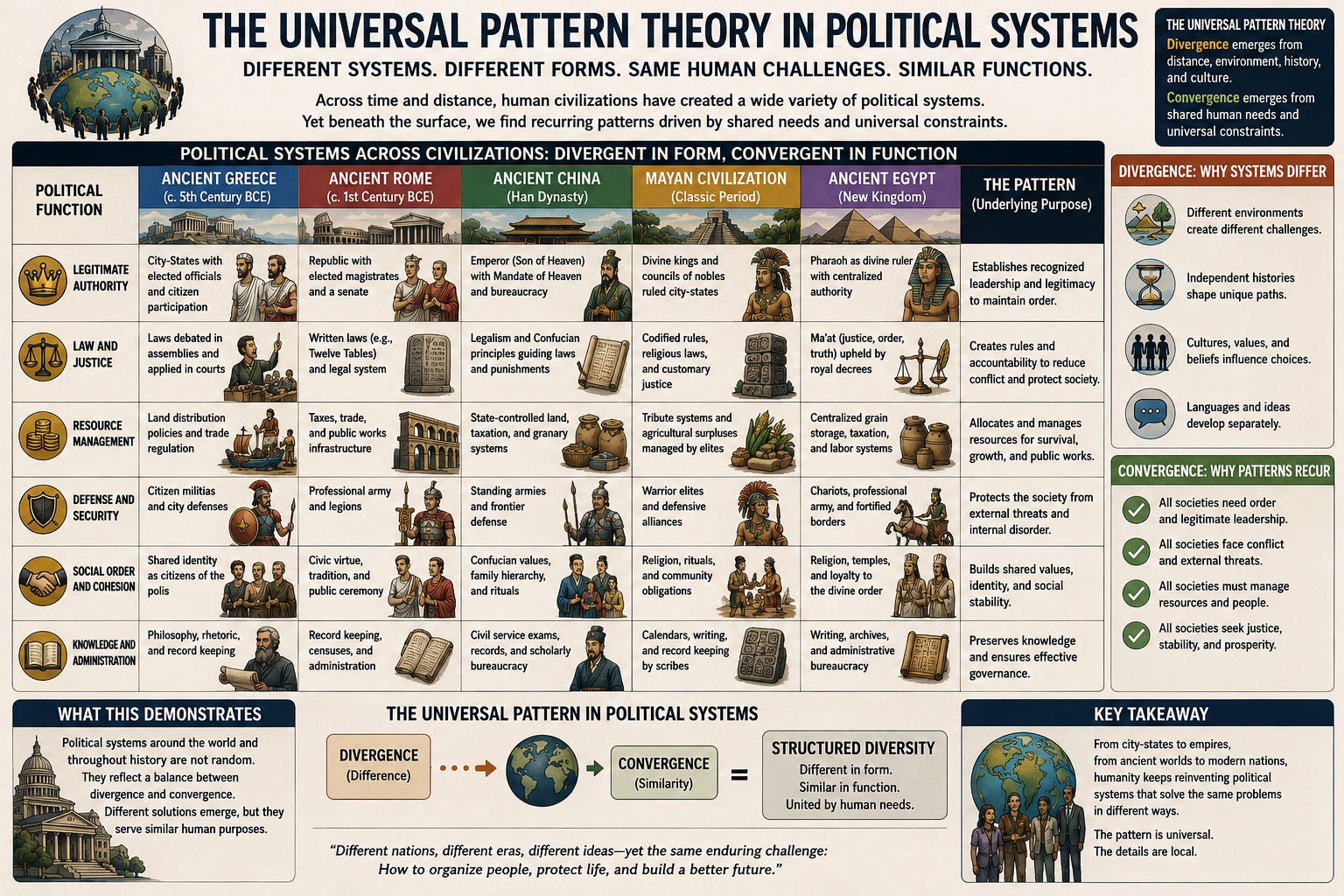
Political systems offer a useful illustration of this balance. A democracy, monarchy, technocracy, or artificial intelligence governed society may appear fundamentally different in structure and ideology. Yet each system must address many of the same practical concerns involving leadership, legitimacy, resource allocation, security, and conflict resolution. Divergence determines how these challenges are addressed. Convergence ensures that the challenges themselves remain recognizable. The result is variation within a broader pattern of functional similarity.
Economic systems reveal a similar dynamic. Different societies have experimented with market economies, command economies, mixed systems, and communal arrangements. Despite these differences, every society must determine how resources are produced, distributed, and consumed. The methods vary while the underlying function remains constant. Universal Pattern Theory therefore predicts that intelligent civilizations throughout the universe may develop diverse economic models that nevertheless address common resource management problems.
The framework also suggests that future discoveries should reveal both novelty and familiarity. Researchers examining alien civilizations, advanced artificial intelligences, or previously unknown social systems should expect to encounter unique adaptations alongside recognizable patterns. Extreme differences should not eliminate the possibility of understanding. Likewise, recurring patterns should not be mistaken for complete similarity. The interaction between divergence and convergence creates a universe that is simultaneously diverse and ordered, unfamiliar and understandable.
From Human History to Universal Application
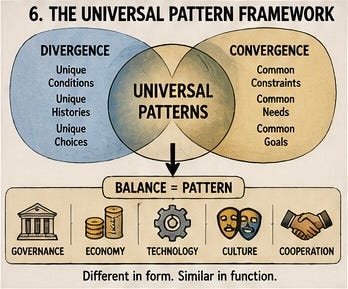
The strongest evidence supporting the logic of Universal Pattern Theory may come from human history itself. Throughout the world, civilizations developed independently while confronting many of the same fundamental challenges. Societies separated by vast distances established governments, legal systems, religious traditions, military organizations, and economic institutions. The specific forms varied considerably, yet recurring patterns repeatedly emerged. These similarities appeared despite significant differences in language, culture, and historical experience.
Ancient civilizations in Asia, Africa, Europe, and the Americas illustrate this phenomenon. Independent societies often developed agriculture, urban centers, systems of authority, and mechanisms for social coordination without direct contact. The timing and details differed, but the broad patterns remained recognizable. Universal Pattern Theory interprets these developments as evidence that intelligent societies frequently converge upon functional solutions while preserving substantial cultural diversity. Similar pressures produced similar responses despite different contexts.
The theory extends this observation beyond humanity. If recurring patterns emerge among civilizations separated by oceans and continents, they may also emerge among civilizations separated by stars and galaxies. The scale changes dramatically, but the underlying logic remains consistent. Intelligent actors operating within reality must still solve problems associated with survival, cooperation, adaptation, and resource management. These requirements create the possibility of recognizable patterns even across immense distances.
Ultimately, Universal Pattern Theory proposes that the universe may be characterized by structured diversity. Intelligent civilizations are neither identical copies nor incomprehensible anomalies. They are products of recurring forces that generate both variation and pattern. Understanding this relationship may provide a foundation for future research into comparative civilization, first contact scenarios, artificial intelligence governance, and the long-term evolution of intelligent life throughout the cosmos.
Implications for First Contact
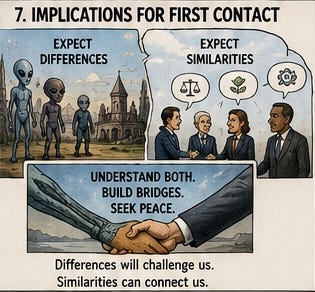
One of the most significant applications of the Universal Pattern Theory concerns the possibility of first contact between humanity and an extraterrestrial civilization. Public discussion of this scenario often fluctuates between two extreme assumptions. The first assumes that extraterrestrials would be sufficiently similar to humans that communication and cooperation would occur naturally. The second assumes that alien civilizations would be so fundamentally different that meaningful interaction would be nearly impossible. Universal Pattern Theory suggests that both assumptions are incomplete because they fail to account for the simultaneous influence of divergence and convergence.
The theory predicts that humanity would likely encounter substantial differences in biology, culture, language, social organization, and historical experience. Civilizations separated by light years and millions of years of independent development would almost certainly possess perspectives and institutions unfamiliar to human observers. Religious beliefs, social customs, concepts of identity, and political structures may differ dramatically from anything found on Earth. Such differences could create misunderstandings and complicate diplomatic engagement. Policymakers would therefore need to approach first contact with humility and a willingness to challenge long held assumptions.
At the same time, the theory predicts that certain similarities should emerge despite profound differences. Any civilization capable of advanced technological development must have solved recurring problems associated with survival, coordination, innovation, and resource management. Such societies would likely possess mechanisms for preserving knowledge, regulating behavior, allocating resources, and resolving disputes. While the forms of these institutions may differ from human equivalents, their functions may be recognizable. Shared challenges could provide the foundation for communication and cooperation even in the presence of significant cultural distance.
This perspective carries important implications for strategic planning. Governments and international organizations preparing for potential first contact should avoid assumptions of either complete compatibility or complete incompatibility. Instead, they should anticipate a mixture of familiar patterns and unfamiliar characteristics. The most successful approach may involve identifying common functional interests while respecting profound differences in worldview and development. Universal Pattern Theory therefore provides a framework for balancing caution with optimism in discussions regarding extraterrestrial engagement.
Political and Strategic Applications

Although the theory is often discussed in relation to extraterrestrial civilizations, its relevance extends well beyond the search for life beyond Earth. Universal Pattern Theory can also be applied to comparative politics, international relations, and the study of governance. Human societies demonstrate many of the same dynamics the theory predicts for intelligent civilizations in general. Nations develop unique cultures and institutions while simultaneously exhibiting recurring patterns associated with survival, security, and social organization.
The history of state formation illustrates this principle. Governments emerged independently across different regions of the world, yet many developed comparable institutions such as legal systems, military organizations, taxation structures, and administrative bureaucracies. These similarities did not arise because every civilization followed the same path. Rather, they emerged because governments confronted many of the same challenges involving order, resource management, and collective action. Universal Pattern Theory interprets these recurring developments as evidence of convergent pressures operating within diverse environments.
The theory may also contribute to understanding international relations. States often differ dramatically in ideology, culture, and political organization, yet they continue to pursue many of the same strategic objectives. National security, economic stability, territorial integrity, and political legitimacy remain recurring concerns across vastly different systems of government. These common interests frequently shape state behavior regardless of cultural differences. As a result, recurring patterns emerge even among actors with fundamentally different identities and values.
From a strategic perspective, the theory encourages policymakers to focus on underlying functions rather than superficial appearances. Understanding how other societies solve common problems may provide greater insight than concentrating exclusively on visible differences. This approach could improve diplomatic engagement, conflict resolution, and international cooperation by identifying areas of convergence beneath apparent divergence. In an increasingly interconnected world, such analytical tools may become increasingly valuable.
Toward a Mathematical Framework
Like many grand theories in the social sciences, Universal Pattern Theory remains primarily conceptual rather than mathematical. Nevertheless, the theory lends itself to quantitative modeling because it describes relationships among identifiable variables. A mathematical framework would not eliminate complexity, but it could provide a structured method for comparing civilizations and evaluating theoretical predictions. Such a framework could also facilitate future interdisciplinary research involving political science, sociology, economics, anthropology, and astrobiology.
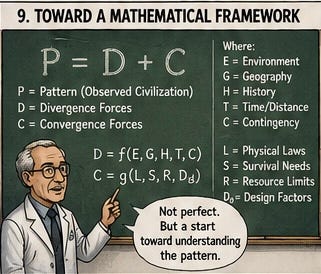
At its simplest level, the theory proposes that observable civilizational characteristics are influenced by both convergent and divergent forces. This relationship may be represented as:
P = D + C
Where P represents the overall pattern of civilization, D represents divergent forces, and C represents convergent forces. Under this formulation, neither diversity nor similarity alone determines developmental outcomes. Instead, observable characteristics emerge from the interaction of both categories of influence.
A more detailed version might divide divergence and convergence into component variables. Divergence could include environmental variation, geographic separation, and historical contingency. Convergence could include physical laws, survival requirements, resource constraints, and common design factors. The resulting framework would allow researchers to examine how different variables contribute to civilizational development. Although precise measurement may prove difficult, the model provides a starting point for systematic analysis.
Future researchers may eventually develop more sophisticated equations capable of estimating the relative influence of specific variables. Such efforts could parallel attempts within economics and political science to model complex social behavior. While no equation can fully capture the complexity of intelligent civilization, mathematical modeling may help transform the theory from a philosophical framework into a testable analytical tool. This progression would represent an important step toward greater academic rigor.
Relationship to Existing Principles
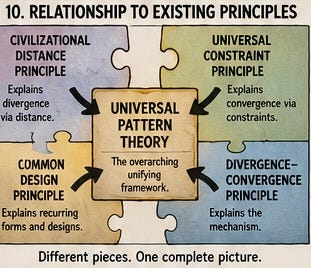
The Universal Pattern Theory functions as an overarching framework that incorporates several previously proposed concepts. Rather than replacing these theories, it provides a structure through which they can be understood as complementary components of a larger explanatory model. Each principle addresses a specific aspect of intelligent development, while Universal Pattern Theory explains how those aspects interact.
The Civilizational Distance Principle focuses primarily on divergence. It explains why civilizations become increasingly different as physical, cultural, temporal, or interstellar distance increases. Independent development encourages variation in institutions, technologies, beliefs, and social structures. Universal Pattern Theory incorporates this insight by recognizing distance as one of the primary mechanisms through which diversity emerges. The principle therefore represents a foundational component of the broader framework.
The Universal Constraint Principle focuses on convergence. It argues that all intelligent civilizations must operate within common physical, environmental, and resource limitations. These constraints narrow the range of viable solutions available to any society. Universal Pattern Theory incorporates this principle by treating constraints as one of the primary sources of recurring patterns. Similar challenges often generate similar functional responses regardless of cultural differences.
The Common Design Principle and the Divergence Convergence Principle complete the framework. The Common Design Principle explains why recurring biological or structural patterns may emerge across different forms of life. The Divergence Convergence Principle explains the mechanism through which diversity and similarity coexist. Universal Pattern Theory synthesizes these concepts into a single model, providing a comprehensive explanation for both variation and recurring structure throughout intelligent civilization.
Criticisms and Limitations
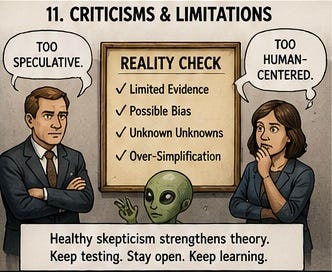
Like any broad theoretical framework, Universal Pattern Theory faces several important limitations. The most significant challenge is the absence of direct empirical evidence regarding extraterrestrial civilizations. At present, humanity possesses only one confirmed example of intelligent civilization: itself. Any attempt to develop universal explanations therefore relies heavily on inference, analogy, and theoretical reasoning. Critics may argue that conclusions about extraterrestrial societies remain speculative until additional evidence becomes available.
A second criticism concerns the risk of anthropocentrism. Human observers naturally interpret the universe through the lens of human experience. Patterns that appear universal may simply reflect assumptions derived from Earth’s unique history and environment. Future discoveries may reveal forms of intelligence that challenge many of the concepts currently considered fundamental. Researchers must therefore remain cautious about projecting human characteristics onto unknown civilizations.
The theory may also underestimate the extent of possible divergence. While common constraints encourage recurring patterns, there is no guarantee that all intelligent life will respond to those constraints in comparable ways. Different biological structures, sensory systems, or cognitive architectures could produce outcomes that appear radically unfamiliar. In some cases, convergence may prove weaker than the theory predicts. This possibility highlights the importance of maintaining flexibility in future applications of the framework.
Despite these limitations, the theory remains valuable as a conceptual tool. Its purpose is not to provide definitive answers regarding every possible civilization. Rather, it seeks to organize existing observations and generate testable predictions. Like many early scientific theories, its usefulness may ultimately depend on its ability to guide future inquiry and stimulate productive debate. The discovery of extraterrestrial intelligence would provide the most significant opportunity to evaluate its claims.
Conclusion and Future Research Directions

The Universal Pattern Theory proposes that intelligent civilizations emerge through the interaction of divergence and convergence. Diversity arises from distance, environmental variation, and independent historical development. Similarity arises from common constraints, shared survival requirements, and potentially recurring design structures. Together these forces generate civilizations that differ in detail while exhibiting recognizable patterns in function and organization. The theory therefore offers a framework for understanding both uniqueness and commonality within intelligent life.
As a meta theory, Universal Pattern Theory integrates the Civilizational Distance Principle, Universal Constraint Principle, Common Design Principle, and Divergence Convergence Principle into a unified analytical model. Each of these concepts explains a specific aspect of civilizational development. Combined, they provide a broader explanation for why intelligent societies may be simultaneously diverse and familiar. The resulting framework extends beyond extraterrestrial life and can be applied to political systems, economic institutions, technological development, and emerging artificial intelligences.
The theory’s greatest contribution may be its rejection of false choices. Intelligent civilizations do not need to be either identical or incomprehensibly different. Human societies themselves demonstrate that diversity and recurring patterns can coexist. Universal Pattern Theory extends this observation to the largest possible scale by suggesting that the universe may be characterized by structured diversity. Difference and similarity are not opposing outcomes but complementary products of the same developmental process.
Future research should focus on refining the theory’s concepts, developing measurable variables, and exploring applications across multiple disciplines. Comparative political analysis, systems theory, artificial intelligence research, and astrobiology may all contribute valuable insights. The eventual discovery of extraterrestrial intelligence would provide an unprecedented opportunity to evaluate the theory’s predictions. Until that day, Universal Pattern Theory offers a framework for thinking systematically about one of humanity’s oldest questions: whether intelligent life throughout the universe is fundamentally unique, fundamentally similar, or both at the same time.