

The Enforcement Gap
Rethinking International Law Through Shared Sovereignty

Executive Summary
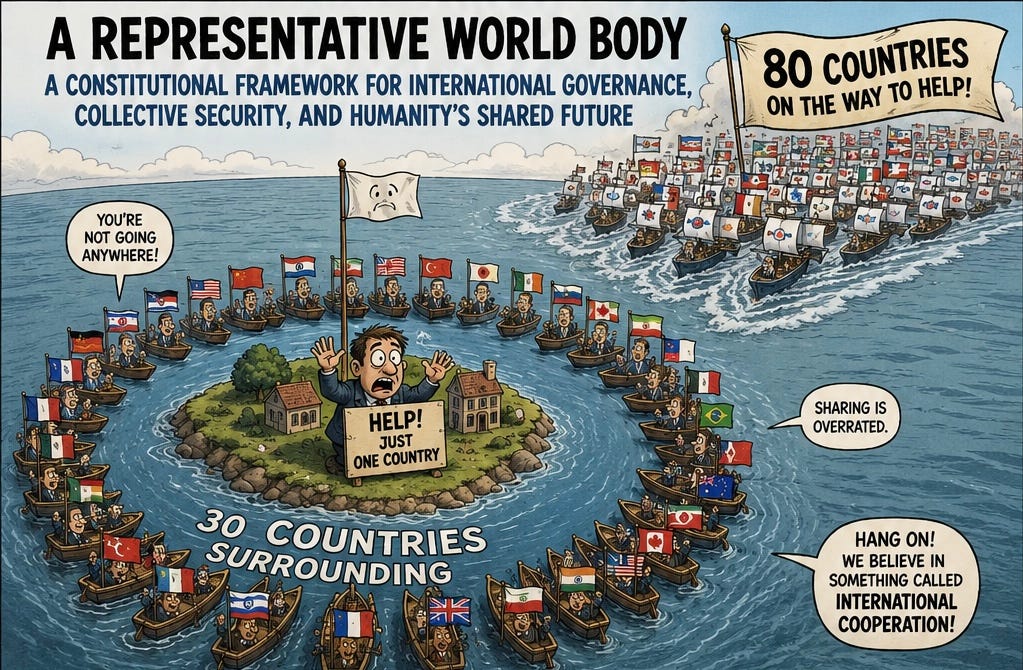
The international system has undergone remarkable transformation since the end of the Second World War. Nations have established treaties governing trade, diplomacy, human rights, maritime navigation, aviation, environmental protection, and the conduct of armed conflict. International organizations have expanded cooperation in nearly every area of global affairs, reflecting a shared recognition that many challenges extend beyond national borders. Despite these achievements, one structural weakness remains largely unresolved. International law lacks a consistent and impartial mechanism capable of enforcing its rules when states refuse to comply.
Unlike domestic governments, the international community does not possess a universally accepted authority capable of compelling compliance with legal obligations. Courts may issue judgments, treaties may establish responsibilities, and diplomatic bodies may adopt resolutions, yet enforcement often depends upon the political interests of individual nations rather than a uniform application of legal principles. Powerful states frequently possess greater ability to shape outcomes than weaker states, while smaller nations often depend upon military alliances or external assistance to preserve their sovereignty. This uneven system contributes to uncertainty, selective enforcement, and continuing geopolitical competition. As a result, military capability frequently becomes the final guarantor of international agreements rather than law itself.
This paper argues that the long-term stability of the international system may require a carefully designed framework of shared sovereignty rather than unrestricted national independence or an all-powerful world government. A representative world body with narrowly delegated authority, balanced by strong regional unions and constitutional safeguards, could strengthen collective security, coordinate disaster response, promote scientific cooperation, and improve the peaceful resolution of disputes while preserving meaningful national and regional self-government. The objective is not to eliminate sovereignty but to modernize international institutions so they better reflect the interconnected challenges of the twenty-first century. By examining both the opportunities and risks of institutional reform, this paper seeks to contribute to an ongoing discussion about the future of global governance.
Introduction
International law represents one of humanity’s most ambitious political achievements. Throughout history, nations relied primarily upon military power, shifting alliances, and diplomatic negotiations to manage disputes. Over time, however, governments increasingly recognized that predictable legal frameworks could reduce uncertainty, facilitate trade, and encourage peaceful cooperation. This recognition led to the development of treaties, international courts, humanitarian conventions, and organizations dedicated to preserving peace and stability. Although these institutions have achieved significant successes, their authority remains fundamentally limited by the principle of national sovereignty.
Modern governments routinely ask their citizens to obey laws because domestic institutions possess the authority to investigate violations, conduct fair judicial proceedings, and enforce legal judgments. The legitimacy of those legal systems depends not only upon the laws themselves but also upon institutions capable of applying them consistently. International law operates under a different model. While states voluntarily accept legal obligations through treaties and agreements, compliance often depends upon political willingness rather than compulsory enforcement. This distinction creates an institutional gap that continues to shape international politics.
The central question facing policymakers is therefore not whether international cooperation should continue, but whether existing institutions remain sufficient to address increasingly global challenges. Climate change, cyber threats, pandemics, humanitarian crises, transnational crime, space exploration, and emerging technologies frequently transcend national borders. At the same time, military conflicts continue to demonstrate the limitations of legal systems that depend largely upon voluntary compliance. These realities suggest that the international community may eventually confront a choice between preserving existing institutional arrangements or carefully expanding collective mechanisms capable of enforcing agreed-upon rules while respecting democratic accountability and national diversity.
Section I: The Enforcement Gap in International Law
International law occupies a unique position within the global political system because it governs sovereign states rather than individual citizens. Unlike domestic legal systems, where governments possess recognized authority over people living within their jurisdiction, the international system operates through the voluntary participation of independent nations. States negotiate treaties, join international organizations, and recognize legal obligations because cooperation often serves their national interests. However, those same states generally retain the ability to withdraw from agreements, challenge legal interpretations, or refuse compliance when political or security considerations outweigh legal commitments. This structural characteristic distinguishes international law from virtually every domestic legal system in existence. It also explains why enforcement remains one of the greatest unresolved questions in international relations.
The absence of a universally accepted enforcement authority does not mean international law lacks value. On the contrary, international legal frameworks have contributed significantly to global commerce, aviation, maritime navigation, telecommunications, humanitarian assistance, public health cooperation, and diplomatic relations. These systems function effectively because most nations recognize that predictable rules create mutual benefits that outweigh the costs of compliance. In many circumstances, governments voluntarily honor their obligations because doing so strengthens international trust, promotes economic growth, and reduces unnecessary conflict. The challenge emerges when legal obligations collide with perceived national interests, strategic competition, or questions of national survival. During those moments, the limitations of voluntary enforcement become increasingly apparent.
This distinction reveals an important institutional paradox. Humanity has developed increasingly sophisticated international legal principles while leaving their implementation largely dependent upon the political calculations of sovereign governments. Courts may issue judgments, investigative commissions may publish findings, and international organizations may adopt resolutions, yet the practical effect of those actions frequently depends upon whether states choose to cooperate. The strength of international law therefore rests not solely upon legal doctrine but also upon diplomacy, political consensus, and, in some cases, military deterrence. This reliance upon political discretion produces an enforcement gap that continues to shape the behavior of states throughout the international system.
Law Without Consistent Enforcement
Every functioning legal system depends upon more than written laws. It also requires institutions capable of interpreting those laws, resolving disputes, and enforcing legitimate decisions through recognized legal authority. Domestic governments generally achieve this balance through legislatures that create laws, courts that interpret them, and executive agencies that implement judicial decisions. While individual governments differ considerably in effectiveness and legitimacy, most share the common feature of possessing institutions responsible for enforcing legal outcomes. Citizens may disagree with particular laws, but the authority of the legal system itself is generally recognized within national borders.
International law operates according to a fundamentally different principle. Sovereign equality means that no nation automatically exercises legal authority over another independent state. As a result, enforcement mechanisms frequently depend upon diplomatic negotiations, voluntary compliance, economic sanctions, multilateral cooperation, or collective military action authorized through existing international institutions. Each of these tools possesses strengths under certain circumstances, yet each also depends upon political agreement among sovereign governments. When that agreement cannot be reached, enforcement may become inconsistent or unavailable despite the existence of established legal principles.
This inconsistency creates practical consequences for both large and small nations. Larger states often possess greater military, economic, and diplomatic resources with which to defend their interests independently. Smaller nations, by contrast, may rely more heavily upon alliances, regional organizations, or broader international support to protect their sovereignty. The resulting imbalance can produce perceptions that international law is applied unevenly depending upon the relative influence of the states involved. Whether or not those perceptions are always accurate, they influence how governments evaluate both the credibility and effectiveness of international institutions.
The Costs of Selective Enforcement
Selective enforcement presents challenges that extend far beyond individual disputes. When governments believe that legal obligations will be enforced inconsistently, they may become increasingly reluctant to rely upon legal institutions during future crises. Instead, states often invest more heavily in military modernization, strategic alliances, intelligence capabilities, and deterrence as safeguards against uncertainty. While defensive preparation remains a legitimate responsibility of every sovereign government, excessive reliance upon military competition may also increase regional tensions and reduce opportunities for diplomatic resolution. The enforcement gap therefore affects not only legal institutions but also long-term strategic stability.
This dynamic may contribute to what political scientists often describe as a security dilemma. When one nation expands its military capabilities for defensive purposes, neighboring states may interpret those actions as potential threats regardless of their original intent. Those neighbors may respond by increasing their own military preparedness, leading to cycles of competition that neither side originally desired. International law seeks to reduce these dynamics by establishing predictable rules and peaceful dispute resolution mechanisms. However, when confidence in enforcement declines, governments frequently return to traditional calculations based primarily upon military capability rather than legal certainty.
An important philosophical distinction should also be recognized when discussing military conflict. Victory in war demonstrates the ability to prevail under specific political, economic, technological, and military conditions. It does not automatically establish the moral superiority of the victor’s political ideals or system of government. Superior technology, industrial capacity, logistics, intelligence, leadership, geography, and alliances have all influenced the outcomes of wars throughout history. Recognizing this distinction reinforces the importance of strengthening legal institutions capable of evaluating disputes according to shared principles rather than allowing armed conflict alone to determine international outcomes.
Toward a More Credible International System
Recognizing the enforcement gap does not require rejecting the principle of national sovereignty. Rather, it invites policymakers to consider whether certain narrowly defined responsibilities might be exercised more effectively through carefully designed international institutions. Many governments have already accepted limited forms of shared governance in areas such as civil aviation, maritime safety, telecommunications, public health coordination, and international commerce because cooperation produces mutual benefits. These examples demonstrate that sovereignty can be delegated selectively without eliminating national independence. The challenge lies in determining where additional cooperation strengthens both security and liberty simultaneously.
A representative world body could potentially serve as one mechanism for addressing specific enforcement challenges while remaining subject to constitutional limitations and democratic oversight. Rather than exercising unlimited authority, such an institution could receive clearly defined responsibilities delegated voluntarily by member states. Those responsibilities might include coordinating collective responses to aggression, enforcing narrowly defined international legal obligations approved through representative institutions, and supporting peaceful dispute resolution before conflicts escalate into armed confrontation. National governments would continue exercising primary authority over domestic affairs, while regional organizations could provide an additional layer of accountability and representation. Such a model would seek to complement existing sovereignty rather than replace it.
Ultimately, the future of international law depends upon the credibility of the institutions responsible for preserving it. Laws that cannot be implemented consistently risk becoming aspirations rather than effective rules of conduct. Conversely, enforcement without meaningful democratic accountability risks concentrating excessive authority in centralized institutions. The challenge for future generations will therefore be designing a constitutional framework capable of balancing sovereignty, accountability, representation, and collective security. Successfully addressing that challenge may determine whether international law continues evolving as humanity’s primary instrument for resolving disputes peacefully in the decades ahead.
Section II: Collective Security and the Limits of Military Deterrence

Rethinking Security in an Interdependent World
For centuries, national security has been understood primarily through the lens of military strength. Governments have invested enormous resources into building armies, navies, air forces, intelligence services, and strategic deterrence because history has repeatedly demonstrated that nations unable to defend themselves often become vulnerable to coercion or conquest. Military preparedness remains a legitimate responsibility of every sovereign state, particularly in an international system where no universally recognized enforcement authority exists. Yet this model also produces significant costs, including regional arms races, overlapping military expenditures, and persistent uncertainty regarding the intentions of neighboring states. As global challenges become increasingly interconnected, it is worth considering whether security can be strengthened through greater institutional cooperation rather than relying almost exclusively upon national military capabilities.
The current international system places vastly different burdens upon nations depending upon their size, wealth, and geography. Larger countries generally possess greater economic capacity to maintain advanced military forces and sustain long-term defense programs. Smaller states often lack those resources despite facing many of the same security concerns. As a result, many governments rely upon alliances, bilateral security agreements, or the diplomatic support of larger powers to preserve their independence. While these arrangements can provide valuable protection, they are not universally available and frequently depend upon changing geopolitical interests rather than permanent legal obligations.
This disparity raises an important policy question concerning the future of collective security. If international law is intended to protect the sovereignty of all nations equally, should its enforcement depend primarily upon the independent military capabilities of individual states? A representative world body with carefully limited authority could provide a framework in which legal commitments are supported by collective institutions rather than by the relative strength of national militaries alone. Such an approach would not eliminate the need for national defense but could reduce disparities between nations by reinforcing the principle that sovereignty deserves protection regardless of military size. In doing so, the international community could gradually shift from a system centered primarily on deterrence toward one increasingly grounded in shared responsibility.
Collective Defense as a Public Good
One of the most significant advantages of a representative world body would be its ability to extend credible security guarantees to smaller nations that currently possess limited defensive capabilities. Under the existing international system, many countries maintain relatively modest armed forces because their economic resources, geographic size, or population make larger militaries impractical. These governments frequently depend upon diplomacy and regional partnerships to discourage aggression. While diplomacy remains an essential component of international stability, it may prove insufficient when confronted by overwhelming military force. A collective security framework could strengthen deterrence by ensuring that aggression against one member state would generate a coordinated international response rather than leaving individual nations to defend themselves in isolation.
Such a framework would also change the strategic calculations of potential aggressors. Instead of evaluating the military capabilities of a single target, governments contemplating the use of force would need to consider the broader consequences of confronting a unified international response. The objective would not be to create a larger military for its own sake but to reduce the likelihood that military force would be viewed as an effective tool for resolving disputes. Effective deterrence often depends less upon the use of force than upon the credible expectation that unlawful aggression will encounter organized resistance. By strengthening collective commitments, international institutions could make peaceful negotiation a more attractive option before conflicts escalate.
Collective defense may also be understood as a global public good rather than simply a military arrangement. Stable international commerce, humanitarian assistance, scientific cooperation, and economic development all depend upon reasonably secure international conditions. When conflict spreads across regions, the resulting instability frequently disrupts trade, displaces civilian populations, strains neighboring governments, and diverts resources away from long-term development. Strengthening collective security therefore produces benefits that extend well beyond defense policy alone. A more stable international environment creates opportunities for investment, innovation, education, and international cooperation that ultimately serve the interests of both large and small nations.
Military Power and Political Legitimacy
Military capability has long influenced the balance of power among nations, yet history demonstrates that battlefield success alone cannot determine political legitimacy. Victories often reflect advantages in technology, logistics, industrial production, intelligence, leadership, geography, economic resilience, or coalition building. These factors help explain why some nations prevail in war while others do not. They do not, however, resolve deeper questions concerning justice, legality, or the moral foundations of political authority. Separating military success from moral legitimacy remains essential if international law is to serve as more than an extension of military competition.
Throughout history, many military victories have later been reassessed through changing ethical standards and historical scholarship. Governments once celebrated for conquest have sometimes faced later criticism for the methods they employed or the policies they pursued after victory. Likewise, nations that initially suffered military defeat have occasionally come to be recognized for defending principles that later gained broader international acceptance. These examples illustrate that military outcomes and moral evaluation frequently follow different paths. The ability to win a conflict demonstrates capacity, but it does not automatically establish the righteousness of the cause.
A stronger international legal system could help reinforce this distinction by placing greater emphasis upon legal review, diplomatic mediation, and institutional accountability before disputes reach the battlefield. If governments possess greater confidence that grievances can be addressed through credible international institutions, they may become less inclined to rely upon unilateral military action. The purpose of strengthening collective security is therefore not merely to improve defense capabilities but also to elevate the role of law in resolving disputes. Over time, success would be measured less by the number of wars won and more by the number of wars successfully prevented.
The Limits of a World Military
Any proposal involving collective security naturally raises concerns about the concentration of military power. History offers numerous examples of governments that accumulated significant authority only to misuse it against those they were intended to serve. For this reason, any discussion of a representative world body must distinguish between a constitutional system of collective security and an unrestricted global military authority. The objective should never be to replace national sovereignty with centralized coercion. Instead, carefully limited powers should be exercised only under transparent legal procedures established through broad international agreement.
A future collective security institution could operate according to narrowly defined constitutional principles. Military action might require approval through multiple representative bodies rather than a single executive authority. Regional unions could participate directly in authorizing operations, ensuring that no individual institution possesses unilateral control over the use of force. Independent judicial review could determine whether proposed actions satisfy agreed legal standards before implementation. These procedural safeguards would seek to ensure that collective security remains accountable to law rather than becoming an instrument of unchecked political power.
The success of any future international security framework would therefore depend not only upon its ability to deter aggression but also upon its ability to restrain itself. Institutions designed to preserve peace must themselves remain subject to constitutional limitations, democratic oversight, transparency, and meaningful checks on authority. Achieving this balance would undoubtedly present significant challenges, yet constitutional democracies have long demonstrated that divided powers can reduce the risks associated with concentrated authority. Applying similar principles to carefully defined international institutions may provide a foundation for stronger collective security without sacrificing the political diversity and independence that remain essential to the international system.
Section III: Regional Unions as Constitutional Checks on Global Authority
A Constitutional Alternative to Centralization
One of the most common criticisms of global governance is the concern that it could concentrate excessive political authority within a single international institution. Throughout history, governments at every level have demonstrated that power without meaningful oversight can threaten liberty regardless of the intentions of those exercising it. This concern deserves careful consideration because any proposal involving shared sovereignty must also include equally robust mechanisms of accountability. Rather than dismissing these concerns, institutional design should treat them as foundational principles. A representative world body should therefore be constructed upon the same constitutional philosophy that has influenced many successful democratic governments, namely that authority should be divided, limited, and subject to multiple independent checks.
The objective of a representative world body should not be to create a single global government exercising unlimited authority over every nation. Instead, its purpose should be to coordinate a narrow set of responsibilities that no individual nation can effectively manage alone while preserving the primary authority of national governments over domestic affairs. National constitutions already distinguish between local, state or provincial, and national responsibilities because different problems require different levels of governance. The international system could evolve according to a similar principle by recognizing that some challenges are best addressed locally, others regionally, and a limited number globally. Such an approach would preserve political diversity while improving coordination where collective action is clearly beneficial.
This constitutional philosophy recognizes that sovereignty need not exist as an absolute concept exercised exclusively at one level of government. In practice, many nations already participate simultaneously in municipal governments, state or provincial governments, national governments, and regional organizations without eliminating the authority of any one institution. Authority is divided according to function rather than concentrated in a single office. Applying this principle internationally would allow nations to retain meaningful self-government while voluntarily delegating specific responsibilities to regional unions and a representative world body. Shared sovereignty, when carefully defined, becomes a mechanism for cooperation rather than a surrender of independence.
Regional Unions as the Foundation of Global Representation
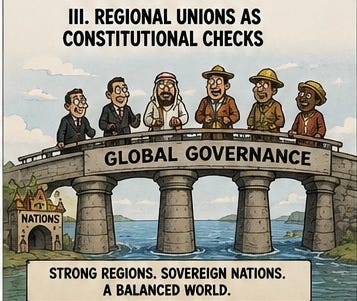
Regional organizations have become increasingly important components of international cooperation because neighboring countries often share common economic interests, security concerns, cultural ties, and geographic realities. Cooperation among neighboring states frequently allows governments to coordinate infrastructure, trade, transportation, environmental policy, disaster response, and regional security more effectively than isolated national efforts. These experiences suggest that regional institutions could serve as an essential bridge between national governments and any future representative world body. Rather than bypassing nations, regional unions could amplify their voices through coordinated representation. This layered approach would strengthen both regional cooperation and global accountability.
A future constitutional framework might envision several broadly representative regional unions corresponding to the major geographic regions of the world. Europe, Africa, Asia, North America, South America, the Middle East, and Oceania could each develop representative institutions reflecting their unique political traditions, cultures, and strategic priorities. Membership, organizational structure, and internal governance would remain matters for the participating nations themselves. The representative world body would therefore receive input from institutions that already understand the challenges facing their respective regions. Such an arrangement would reduce the likelihood that global policy would become disconnected from regional realities.
Regional unions would also encourage greater cooperation among neighboring countries before disputes reached the global level. Many disagreements concerning trade, migration, shared waterways, infrastructure, and border management could be addressed through regional institutions that possess greater familiarity with local conditions. Only matters involving broader international consequences would require consideration by the representative world body. This layered system would promote subsidiarity, the principle that decisions should be made at the lowest effective level of governance whenever possible. By reserving global authority for genuinely global issues, the international system could remain both more efficient and more democratic.
A System of Institutional Checks and Balances
Effective constitutional systems rarely rely upon a single institution to exercise unchecked authority. Instead, legislatures, executives, courts, and regional governments often possess overlapping responsibilities designed to prevent excessive concentration of power. A representative world body could adopt a similar philosophy by distributing authority among multiple institutions that balance one another. Rather than creating a centralized hierarchy, international governance could operate through shared decision making requiring agreement across several representative bodies. Such an arrangement would encourage negotiation while reducing opportunities for unilateral action.
One possible framework would establish a World Assembly in which every sovereign nation receives one vote, affirming the principle of sovereign equality under international law. A second chamber could consist of representatives selected by the major regional unions, providing an institutional voice for broader geographic interests and helping balance differences in population, economic power, and regional priorities. Major international decisions could require approval from both bodies before taking effect. This bicameral approach would reduce the likelihood that either large or small states could dominate global decision making independently. It would also encourage coalition building across regions rather than competition among individual powers.
Additional safeguards could further strengthen accountability. An independent international judiciary could review whether proposed actions comply with the constitutional framework and the limited authorities delegated to the representative world body. Public transparency requirements could ensure that deliberations, budgets, and legal opinions remain available for international scrutiny whenever national security considerations do not require temporary confidentiality. Independent auditing institutions could oversee financial accountability, while regular constitutional review conferences would permit member states to amend or clarify institutional responsibilities through broad international consensus. Together, these mechanisms would seek to establish a government of laws rather than a government of personalities.
Shared Sovereignty as a Partnership Rather Than a Transfer of Power
Discussions of global governance often assume that sovereignty can only be possessed or surrendered. This assumption overlooks the reality that modern governance already operates through multiple layers of shared authority. Citizens routinely participate in local governments, regional administrations, national governments, and international agreements without concluding that any one institution has eliminated the others. The practical question is therefore not whether sovereignty can be shared, but how responsibilities should be allocated among different levels of governance to maximize both liberty and effective administration. A constitutional approach focuses on function rather than ideology.
Under this model, national governments would continue exercising primary authority over criminal law, taxation, education, healthcare, cultural policy, elections, domestic infrastructure, and other internal matters. Regional unions would coordinate issues that naturally extend across neighboring countries, including transportation corridors, environmental management, regional trade, and certain aspects of collective security. The representative world body would remain limited to matters that genuinely affect humanity as a whole, such as international peacekeeping authorized under constitutional procedures, disaster coordination, planetary defense, space governance, pandemic response, and other challenges beyond the practical capacity of any single nation. By clearly defining these jurisdictions, the international community could reduce institutional overlap while preserving meaningful self-government.
Ultimately, constitutional design matters more than institutional size. History demonstrates that small governments may become oppressive when left unchecked, while larger systems may preserve liberty when authority is carefully divided and constrained by law. The enduring challenge is not merely limiting power but distributing it wisely among institutions capable of balancing one another. A representative world body supported by strong regional unions offers one possible framework for achieving that balance. Whether humanity chooses to pursue such a model will depend not only upon political will but also upon the wisdom to design institutions that protect freedom while strengthening international cooperation.
Section IV: Beyond War: Disaster Relief, Scientific Cooperation, Space Exploration, and Humanity’s Shared Future

Global Challenges Require Global Coordination
Although discussions surrounding international institutions frequently focus on war and diplomacy, many of humanity’s greatest challenges arise outside the battlefield. Earthquakes, hurricanes, tsunamis, pandemics, cyberattacks, food insecurity, environmental disasters, and technological disruptions routinely affect multiple nations simultaneously. These events often overwhelm the capabilities of individual governments regardless of their economic strength or political system. In many cases, the speed of response determines whether thousands or millions of lives are saved. As the world becomes increasingly interconnected through trade, communications, and transportation, the need for coordinated international action becomes increasingly apparent.
Most existing international responses rely upon temporary coalitions assembled after disasters have already occurred. Governments contribute personnel, equipment, financial assistance, and humanitarian supplies according to their available resources and political priorities. While these efforts have often saved countless lives, they also reveal the limitations of an international system built primarily upon voluntary coordination. Delays in communication, uncertainty regarding available resources, and overlapping administrative responsibilities can slow relief efforts during the most critical periods. A permanent institutional framework could improve readiness long before disasters occur.
A representative world body with narrowly defined humanitarian responsibilities could establish standardized emergency procedures without replacing national emergency management agencies. International logistics centers could coordinate transportation, medical supplies, engineering teams, satellite imagery, communications systems, and emergency funding through preexisting agreements rather than improvised negotiations. Nations would continue directing domestic disaster operations while benefiting from rapid international reinforcement when local capacity becomes overwhelmed. Such a framework would recognize that natural disasters do not distinguish between political ideologies, economic systems, or national borders. Humanity’s response to shared suffering should therefore be guided by preparedness rather than improvisation.
Building a Permanent Global Humanitarian Infrastructure
One of the most valuable contributions of a representative world body would be the creation of permanent humanitarian institutions capable of responding immediately to international emergencies. Rather than maintaining separate systems that may or may not coordinate effectively during crises, member nations could voluntarily contribute personnel, specialized equipment, transportation assets, and emergency funding to a common international reserve. These resources would remain under constitutional oversight and could only be activated under clearly defined legal circumstances approved through representative institutions. By establishing these mechanisms before disasters occur, the international community could significantly reduce delays associated with emergency mobilization.
Medical cooperation provides an especially compelling example of the potential benefits of institutional coordination. Future pandemics, emerging infectious diseases, and large-scale humanitarian emergencies will likely require rapid sharing of scientific information, laboratory research, medical personnel, pharmaceuticals, and public health expertise. Individual governments possess considerable medical capabilities, yet disease spreads without regard for national boundaries. A permanent international framework could facilitate faster information sharing while respecting national public health authorities and scientific independence. The objective would be to improve coordination rather than centralize healthcare policy.
The same principle extends beyond medicine into engineering, infrastructure restoration, food distribution, communications, and refugee assistance. Following major natural disasters, governments frequently require temporary support rebuilding transportation systems, restoring electrical infrastructure, repairing water treatment facilities, and coordinating humanitarian logistics. Instead of depending solely upon bilateral aid agreements negotiated after each crisis, member nations could rely upon standing institutions specifically designed for these circumstances. Such preparation would not eliminate tragedy, but it could substantially reduce human suffering through faster and more organized international cooperation.
Scientific Cooperation as an Investment in Humanity
Scientific progress has historically accelerated when knowledge, resources, and expertise are shared across national boundaries. Advances in medicine, astronomy, engineering, agriculture, communications, and environmental science have frequently resulted from collaboration among researchers representing diverse countries and institutions. Although healthy competition often stimulates innovation, unnecessary duplication of expensive research projects can divert resources that might otherwise advance scientific discovery. A representative world body could encourage greater international cooperation while respecting the independence of national research institutions. The purpose would be to expand humanity’s collective capacity for discovery rather than replace existing scientific organizations.
Large-scale scientific initiatives increasingly exceed the practical capabilities of many individual nations acting alone. Projects involving fusion energy, quantum computing, deep-ocean exploration, planetary defense, advanced medical research, and climate observation often require decades of sustained investment and international collaboration. Shared funding mechanisms could distribute financial responsibility among participating nations while ensuring that scientific benefits remain broadly accessible. Such cooperation would reduce unnecessary duplication while allowing countries of varying economic capacity to contribute according to their available resources. Science would become not merely a national investment but a shared civilizational endeavor.
International scientific cooperation also possesses important diplomatic value. Collaborative research creates relationships among universities, laboratories, engineers, physicians, and technical specialists that often continue despite periods of political disagreement between governments. These professional networks encourage dialogue, mutual understanding, and the peaceful exchange of knowledge across cultural and ideological boundaries. While scientific cooperation cannot eliminate geopolitical competition entirely, it can establish channels of communication that remain valuable during periods of international tension. In this sense, science becomes both a driver of innovation and an instrument of long-term peacebuilding.
Humanity’s Future Beyond Earth
Space exploration represents one of the clearest examples of an undertaking that naturally invites international cooperation. Establishing permanent lunar facilities, conducting human missions to Mars, developing asteroid mining technologies, constructing planetary defense systems, and expanding astronomical research require extraordinary financial, scientific, and engineering resources. Many nations have already demonstrated impressive capabilities in space exploration, yet the scale of future missions may increasingly favor collaborative investment rather than isolated competition. A representative world body could provide an institutional framework through which nations voluntarily coordinate ambitious projects that advance the interests of humanity as a whole. Shared exploration need not diminish national achievement but may instead amplify it.
Planetary defense offers an especially compelling rationale for international cooperation. Near-Earth asteroids, solar storms, and other natural hazards present risks that affect every nation regardless of political alignment or geographic location. Detecting, tracking, and potentially mitigating these threats requires coordinated observation systems, shared scientific data, and agreed emergency procedures. Because no single nation owns the planet, protecting Earth from naturally occurring existential risks represents a responsibility shared by all humanity. Cooperative institutions provide the most practical means of organizing such efforts before emergencies arise.
The expansion of human activity into space also raises important questions regarding future governance. As permanent settlements, commercial enterprises, and scientific installations become more common beyond Earth, nations will likely confront new legal and diplomatic challenges involving resource management, environmental protection, and peaceful coexistence. A representative world body with carefully limited authority could assist in developing legal frameworks that encourage cooperation while preventing unnecessary conflict. Such institutions would not govern human civilization in space but could facilitate dialogue among sovereign participants engaged in shared exploration. Preparing these legal foundations today may reduce uncertainty as humanity enters a new era of exploration.
Preparing for Extraordinary Possibilities
Although discussions concerning extraterrestrial intelligence remain speculative, responsible governance requires considering low-probability events with potentially profound consequences. Throughout history, governments have developed contingency plans for natural disasters, emerging diseases, technological failures, and other unlikely scenarios because the consequences of inadequate preparation can be significant. Contact with an extraterrestrial civilization would almost certainly affect humanity collectively rather than any single nation. Questions concerning communication, scientific investigation, diplomacy, public information, and international security would extend beyond existing national jurisdictions. Preparing institutional procedures does not presume that such contact will occur, but it reflects prudent long-term planning.
A representative world body could provide a neutral forum through which nations coordinate scientific evaluation, diplomatic communication, and international decision making should extraordinary circumstances arise. Decisions of such importance would benefit from broad international participation rather than fragmented national responses that might generate misunderstanding or unnecessary competition. Constitutional safeguards, transparency requirements, and scientific oversight would remain essential to maintaining public trust throughout any such process. The objective would not be to centralize authority but to ensure that humanity responds thoughtfully and cooperatively to unprecedented events. Even if these preparations are never required, the institutional capacity developed for them could strengthen international cooperation in many other areas.
Ultimately, the broader value of a representative world body extends beyond preventing conflict. Its greatest contribution may lie in helping humanity organize around shared aspirations rather than shared fears. Disaster relief, scientific discovery, public health, environmental stewardship, space exploration, and preparations for future challenges all reflect opportunities for constructive international cooperation. These endeavors remind us that civilization advances not only through competition but also through collaboration. If the twenty-first century becomes defined by humanity’s ability to solve problems collectively, then institutions designed for cooperation may prove as important to history as those originally designed for war.
Section V: A Constitutional Framework for a Representative World Body
From International Organization to Constitutional Institution
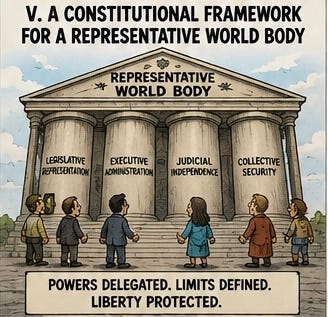
If humanity ever chooses to strengthen international governance, institutional design will determine whether such a system protects liberty or concentrates authority. History demonstrates that stable political systems are not created simply by granting power to governments. They endure because power is carefully distributed among competing institutions that monitor, restrain, and balance one another. Constitutional democracies generally recognize that no individual, legislature, court, or executive should exercise unlimited authority. Those same constitutional principles should guide any future representative world body.
The objective should not be to replace sovereign nations with a centralized global government. National governments remain the institutions most familiar with the cultures, traditions, histories, and constitutional values of their own citizens. Domestic policy concerning education, taxation, criminal justice, healthcare, elections, property rights, and cultural affairs should continue to remain primarily within national jurisdiction. A representative world body should instead receive authority only in areas where international cooperation clearly produces better outcomes than independent national action. Clearly defining those responsibilities would help prevent unnecessary institutional expansion over time.
Constitutional limitations would therefore become as important as constitutional powers. Every delegated authority should be explicitly identified, publicly debated, and approved through democratic procedures before becoming effective. Any powers not specifically delegated to the representative world body would remain with sovereign nations or regional unions. This principle would establish a presumption in favor of national self government rather than centralized administration. In effect, the constitution would exist not merely to authorize government but to define its limits.
A Bicameral Model for Global Representation
One possible institutional design would establish a bicameral legislative system modeled upon the principle that both sovereign equality and regional representation deserve constitutional recognition. The first chamber, referred to here as the World Assembly, would consist of one representative vote for every sovereign member state. This arrangement would affirm the longstanding principle that every recognized nation possesses equal legal standing regardless of population, economic size, or military capability. Smaller countries would therefore retain a meaningful voice within the legislative process. Equal representation would reinforce the legitimacy of international law by recognizing the sovereign dignity of every member nation.
The second chamber could be organized around regional unions rather than individual countries. Europe, Africa, Asia, North America, South America, the Middle East, and Oceania would each determine their own methods for selecting delegates according to constitutional procedures established within their respective regions. This chamber would encourage regional cooperation while ensuring that broader geographic interests receive institutional representation alongside individual states. Large multinational issues often affect neighboring countries in similar ways, making regional coordination both practical and politically valuable. Regional participation would also reduce the likelihood that any single group of nations could dominate global legislation without broader international consensus.
Major legislation could require approval from both chambers before becoming binding international law. This bicameral structure would encourage negotiation between national and regional perspectives while making unilateral decision making considerably more difficult. Compromise would become an institutional necessity rather than a political afterthought. Governments seeking broad international action would need to persuade both sovereign states and regional representatives that proposed measures serve the common interest. Such a process would inevitably require patience, yet constitutional systems often favor deliberate decision making over rapid concentration of authority.
Executive Authority Under Constitutional Constraint
Any representative world body would require an executive institution capable of administering programs approved through constitutional procedures. The executive branch, however, should remain administrative rather than presidential in character. Its primary responsibility would be implementing policies authorized through representative institutions rather than independently determining international policy. Executive officials would therefore function more as constitutional administrators than political rulers. Their authority would remain subject to legislative oversight, judicial review, financial auditing, and public transparency requirements.
Executive agencies could coordinate disaster response, humanitarian logistics, international scientific programs, peacekeeping administration, environmental monitoring, and other constitutionally delegated responsibilities. These agencies would operate according to laws enacted through the representative legislative process rather than exercising broad discretionary authority. Funding would require regular legislative approval, while independent inspectors could evaluate both efficiency and legal compliance. Transparency reports, public budgets, and performance reviews would strengthen institutional accountability. Administrative effectiveness would therefore develop alongside constitutional restraint.
Leadership selection should likewise emphasize institutional stability rather than personal influence. Executive officers might serve fixed terms with clearly defined responsibilities and limited opportunities for reelection. Appointment procedures could require approval from both legislative chambers, encouraging broad international confidence rather than narrow political support. Removal procedures should also exist for misconduct, abuse of authority, or constitutional violations. These safeguards would reinforce the principle that no executive office exists above the constitutional order it is entrusted to administer.
An Independent International Judiciary
No constitutional system remains credible without an independent judiciary capable of interpreting the law impartially. A representative world body would therefore require a judicial branch responsible for resolving disputes concerning constitutional authority, treaty interpretation, institutional jurisdiction, and international legal obligations. Judges should be selected through transparent procedures designed to emphasize professional qualifications, judicial independence, and geographic diversity rather than political loyalty. Fixed terms or carefully structured appointments could further strengthen impartiality. Public confidence depends not only upon judicial competence but also upon the appearance of institutional neutrality.
The judiciary would also serve as an essential safeguard against unconstitutional expansion of authority. Legislative bodies occasionally exceed their intended powers, while executive agencies may interpret statutes more broadly than originally authorized. An independent constitutional court could review such actions to determine whether they remain consistent with the limited authorities delegated by member states. Judicial review would therefore protect both the representative world body and the sovereignty of participating nations. Constitutional limitations become meaningful only when independent institutions possess the authority to enforce them.
Access to the judicial process should extend beyond governments whenever appropriate constitutional procedures permit. Regional unions, authorized international agencies, and other constitutionally recognized institutions could petition the court regarding disputes involving delegated authority. Public publication of judicial opinions would encourage transparency while contributing to the gradual development of international constitutional jurisprudence. Over time, consistent legal interpretation would strengthen institutional predictability and reinforce confidence in the rule of law. Stable legal systems depend as much upon impartial adjudication as they do upon carefully written constitutions.
Collective Security Under Civilian Authority
Perhaps no constitutional question requires greater caution than the lawful use of military force. The representative world body should never possess unrestricted authority to deploy armed force according to the preferences of a single executive or legislative institution. Instead, any collective security mechanism should remain firmly subordinate to constitutional procedures requiring multiple layers of approval. Military action should always represent a measure of last resort after diplomatic, legal, and economic alternatives have been thoroughly considered. Civilian institutions must retain ultimate authority over every stage of the decision making process.
One possible framework would require approval from both legislative chambers before authorizing collective security operations, followed by constitutional review confirming that the proposed action satisfies the legal standards established within the founding charter. Regional unions directly affected by the proposed operation could also participate in the deliberative process before final authorization. Clear mission objectives, defined operational limits, periodic legislative review, and automatic expiration provisions would prevent open ended military commitments. Funding authorization should remain separate from operational approval, ensuring continued legislative oversight throughout any mission. Such procedures would prioritize accountability over speed while preserving the ability to respond collectively when truly necessary.
The military forces participating in collective security operations need not constitute a permanent global army. Instead, member nations could voluntarily contribute personnel, equipment, logistics, and specialized capabilities under agreed constitutional procedures for specific missions authorized through representative institutions. Operational command would remain temporary and mission specific rather than permanent and centralized. This approach would preserve national military establishments while creating the institutional capacity for lawful collective action when required. In doing so, collective security would strengthen international law without creating an independent military authority beyond constitutional control.
Constitutional Evolution Through Democratic Consent
No constitution should be viewed as permanently complete. Political institutions must retain the ability to adapt responsibly as technology, demographics, scientific understanding, and international conditions evolve over time. At the same time, constitutional amendment should remain deliberately difficult to prevent temporary political majorities from fundamentally altering the institutional balance established by the founding framework. Stability requires both flexibility and restraint. Successful constitutional systems recognize that enduring legitimacy depends upon balancing those competing objectives.
Future amendments could require approval by supermajorities within both legislative chambers, followed by ratification through member nations or regional unions according to procedures established in the founding charter. This process would encourage broad international consensus before significant institutional changes become effective. Constitutional conventions held at regular intervals could evaluate whether existing structures continue serving the purposes for which they were originally created. Independent constitutional commissions composed of legal scholars, diplomats, scientists, and public policy experts might also provide recommendations without possessing direct legislative authority. Deliberate constitutional evolution would therefore replace abrupt institutional transformation.
Ultimately, a representative world body should derive its legitimacy not from military strength, economic dominance, or historical tradition, but from the informed consent of the nations choosing to participate. Its authority would exist because sovereign states voluntarily determined that limited cooperation in carefully defined areas serves the long term interests of humanity more effectively than isolated action alone. Constitutional government has long demonstrated that liberty and effective administration need not exist in opposition to one another. Applying those principles internationally presents undeniable challenges, yet it also offers an opportunity to rethink how nations cooperate in an increasingly interconnected world. The success of such an institution would depend not upon the amount of power it possesses, but upon the wisdom with which that power is constitutionally restrained.
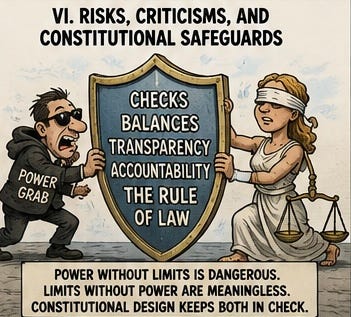
Section VI: Risks, Criticisms, and Constitutional Safeguards
Preserving National Sovereignty
Perhaps the greatest objection to any representative world body is the concern that nations would gradually lose control over their own political futures. Critics often argue that international institutions naturally accumulate authority over time, eventually reducing the independence of sovereign governments. History provides examples of governments at every level expanding beyond their original mandates, making these concerns worthy of serious consideration rather than dismissal. Constitutional design must therefore begin with the assumption that concentrated power presents inherent risks regardless of who exercises it. A successful international framework must protect sovereignty while demonstrating why limited cooperation can strengthen rather than weaken national self government.
The proposal presented throughout this paper does not advocate replacing national constitutions or domestic democratic institutions. National governments would continue exercising primary authority over taxation, education, healthcare, criminal justice, elections, property rights, immigration policy, cultural affairs, and domestic economic regulation. These responsibilities reflect the unique histories, traditions, and constitutional preferences of individual nations. A representative world body would receive only those responsibilities that member nations voluntarily determine cannot be managed effectively through independent action alone. Clearly defined constitutional boundaries would remain essential to maintaining public confidence.
Shared sovereignty should therefore be understood as a constitutional partnership rather than a transfer of political identity. Nations already cooperate through treaties, trade agreements, aviation standards, maritime law, and scientific partnerships without surrendering their independence. The same principle could apply to collective security, humanitarian coordination, planetary defense, and other issues whose consequences extend beyond national borders. Cooperation becomes a practical tool for solving shared problems rather than an ideological commitment to political centralization. Constitutional limitations preserve the distinction between international cooperation and international control.
Preventing the Concentration of Power
Every government possesses the potential to misuse authority if sufficient safeguards are absent. Political philosophy has long recognized that liberty depends less upon trusting individual leaders than upon constructing institutions capable of limiting every leader regardless of personal character. This principle should apply with even greater force to any representative world body because the consequences of institutional abuse would extend across multiple nations. The legitimacy of international governance therefore depends upon its willingness to restrain itself constitutionally. Power must remain accountable to law rather than personality.
Multiple layers of institutional oversight would significantly reduce opportunities for abuse. Bicameral legislation, independent judicial review, regional representation, transparent budgeting, public reporting requirements, independent inspectors, constitutional amendment procedures, and regular institutional audits would each serve different accountability functions. No single institution should possess authority to legislate, interpret the law, administer programs, authorize military operations, and finance its own activities without external review. Divided authority inevitably slows decision making, yet constitutional democracies have repeatedly demonstrated that deliberate governance often produces greater long term stability than concentrated executive power. Institutional friction should therefore be viewed as a constitutional safeguard rather than an administrative weakness.
Technology also offers opportunities to improve accountability beyond what previous generations could reasonably imagine. Public access to legislative proceedings, financial records, judicial opinions, independent audits, and institutional performance metrics could strengthen democratic oversight across national boundaries. Advances in secure communications and digital transparency make it increasingly practical for citizens, journalists, scholars, and civil society organizations to evaluate governmental performance in near real time. Transparency alone cannot prevent institutional abuse, but secrecy frequently enables it. Constitutional openness should therefore become a defining characteristic of any representative international institution.
The Challenge of Political Diversity
Human civilization encompasses extraordinary diversity in language, religion, political philosophy, economic organization, legal tradition, and cultural identity. Any proposal for greater international cooperation must acknowledge that this diversity represents one of humanity’s greatest strengths rather than a problem requiring elimination. Political systems develop in response to different historical experiences and social conditions. No single constitutional model is likely to satisfy every nation equally. Successful international institutions must therefore accommodate diversity rather than attempt to erase it.
Regional unions provide one mechanism through which political diversity can remain institutionally represented. Neighboring nations frequently possess shared historical experiences and common regional priorities while still maintaining distinct constitutional traditions. Regional institutions allow governments to coordinate matters of mutual concern without requiring uniformity across the entire international system. A representative world body built upon regional participation would therefore reflect multiple political perspectives rather than a single ideological framework. Diversity becomes an institutional asset rather than an obstacle to cooperation.
Consensus building will inevitably remain more difficult within a diverse international community than within individual nation states. Decisions involving dozens or even hundreds of governments require patience, negotiation, and compromise. Critics may argue that slower decision making reduces institutional effectiveness during periods of crisis. Yet constitutional democracies have long accepted that careful deliberation often produces more legitimate outcomes than rapid concentration of authority. The challenge lies in balancing efficiency with democratic legitimacy rather than sacrificing one entirely for the other.
Measuring Success
If future generations pursue stronger international institutions, success should not be measured by the amount of authority accumulated by a representative world body. The true measure of success would instead be the ability of those institutions to solve shared problems while preserving liberty, constitutional accountability, and national self government. Institutions exist to serve people rather than the reverse. Their legitimacy depends upon improving the lives of those they represent without unnecessarily restricting political freedom. Constitutional restraint therefore remains as important as institutional capability.
Several practical indicators could help evaluate institutional performance over time. Reductions in interstate conflict, faster humanitarian response, improved disaster coordination, expanded scientific cooperation, stronger protection for smaller nations, greater legal consistency, and increased public confidence would each provide measurable evidence regarding institutional effectiveness. These benchmarks focus upon outcomes rather than bureaucratic expansion. Governments should continually evaluate whether delegated authority continues producing benefits that justify its existence. Accountability requires regular reassessment rather than permanent institutional growth.
Ultimately, constitutional governance depends upon a simple but enduring principle. Political power should always remain the servant of law rather than its master. Whether exercised by local governments, national legislatures, regional unions, or representative international institutions, authority remains legitimate only when it operates within clearly defined constitutional limits. If humanity ever chooses to strengthen international governance, preserving that principle will determine whether future institutions become guardians of liberty or instruments of centralized power.

Conclusion
Human civilization has entered an era in which many of its greatest opportunities and greatest dangers transcend national borders. International commerce connects economies across continents, scientific discoveries emerge through multinational collaboration, diseases spread rapidly through global transportation networks, and environmental events often affect multiple nations simultaneously. At the same time, military conflict continues to demonstrate the limitations of an international legal system that frequently depends upon voluntary compliance rather than consistent institutional enforcement. These realities invite a broader discussion regarding whether political institutions should evolve alongside the increasingly interconnected world they are expected to govern. The purpose of this paper has been to explore one possible constitutional framework for that evolution.
The central argument is not that national sovereignty should disappear, nor that a centralized world government should replace existing nations. Rather, this paper proposes that carefully limited and constitutionally defined forms of shared sovereignty may strengthen both international law and national security when applied to genuinely global challenges. Representative institutions balanced by strong regional unions, independent judicial review, transparent administration, and clearly delegated powers offer one possible model through which cooperation and accountability might coexist. Such a framework would seek to reduce reliance upon military force as the primary guarantor of international agreements while preserving the political independence of individual nations. Constitutional design, rather than institutional size, remains the determining factor in protecting liberty.
Military history teaches that victory often reflects technological capability, industrial capacity, logistics, leadership, intelligence, geography, and economic resilience. It does not necessarily establish the moral superiority of the political ideals defended by the victorious side. If international disputes increasingly depend upon military outcomes alone, then the principles of justice and law risk becoming secondary to the balance of power. Strengthening institutions capable of resolving disagreements through representative legal processes offers an alternative vision in which legitimacy derives from constitutional procedure rather than battlefield success. Peace becomes not merely the absence of war but the presence of trusted institutions capable of resolving conflict before violence becomes necessary.
The broader purpose of a representative world body extends beyond security alone. Disaster relief, scientific cooperation, pandemic preparedness, planetary defense, environmental stewardship, space exploration, and the peaceful management of emerging technologies all illustrate challenges that no nation can fully address in isolation. These issues demonstrate that cooperation is not simply an idealistic aspiration but an increasingly practical necessity. Institutions designed to coordinate these efforts would not diminish national achievement. Instead, they would provide additional mechanisms through which humanity could pursue shared goals while respecting political diversity and constitutional self government.
Whether such a system will ever emerge remains uncertain. History rarely follows predictable paths, and institutional reform often occurs gradually through practical necessity rather than comprehensive design. Nevertheless, political progress has consistently required societies to reconsider existing assumptions about governance as new challenges arise. The question confronting future generations is therefore not whether humanity will continue cooperating across borders. That process is already well underway. The more profound question is whether our institutions will evolve deliberately through constitutional principles or react only after crises expose the limitations of the systems we have inherited.
A stable international order cannot be built upon military strength alone, just as domestic constitutional government cannot depend solely upon force. Lasting peace requires institutions that command legitimacy because they operate according to law, accountability, representation, and clearly defined limits on political authority. Humanity has already demonstrated its ability to create international law. The challenge that remains is determining whether future generations possess the wisdom to develop institutions capable of enforcing that law consistently while preserving the liberty and diversity that define civilization itself.