

Dark Underworld: The Black Ledger
A Political Thriller Short Story Issue #3

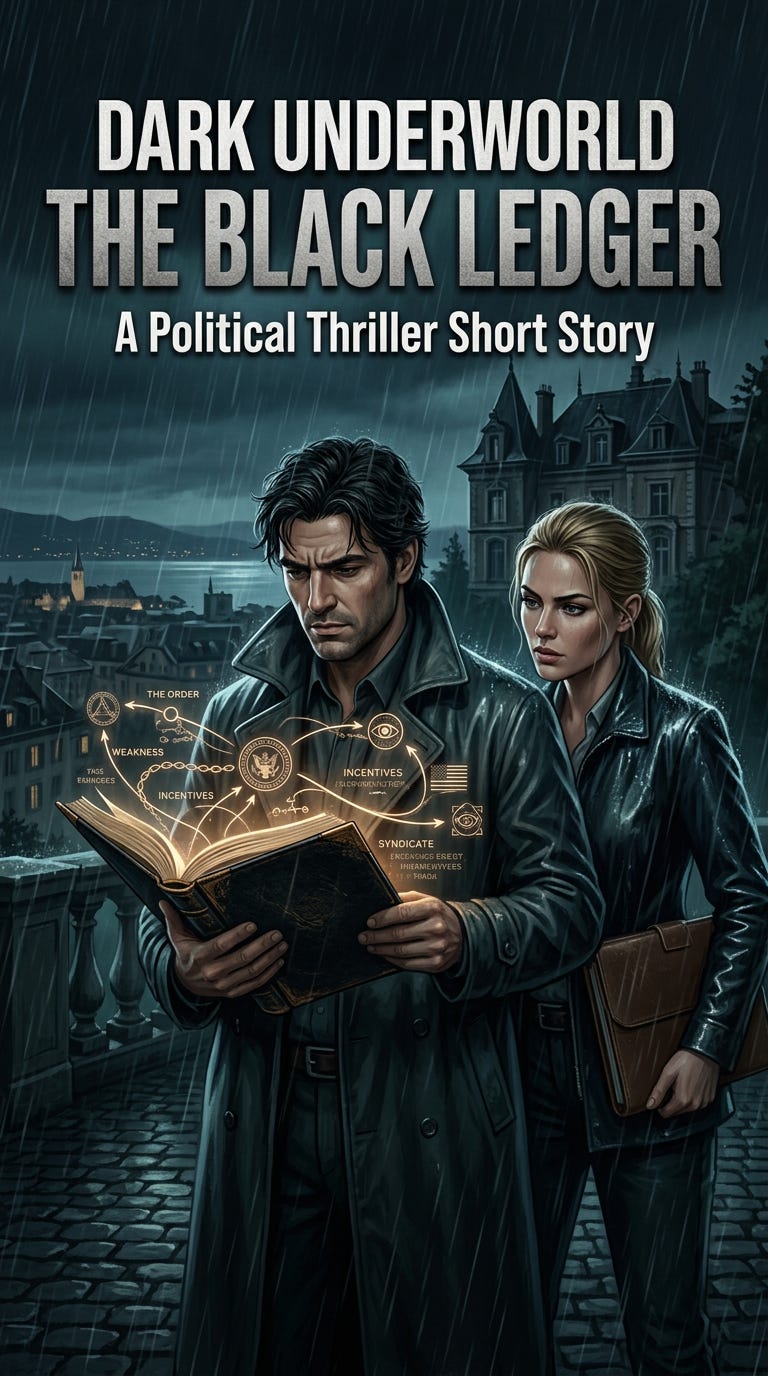
Act I — The Fall of The Order
For a brief moment, the world believed The Order was dead.
The headlines declared victory.
Across television networks, political commentators celebrated the collapse of one of the most secretive organizations ever investigated by international authorities. Congressional committees held hearings. Government officials gave carefully prepared speeches about accountability and reform. Prosecutors announced indictments. Journalists published investigations detailing decades of manipulation.
The public wanted a simple ending.
A villain had been discovered.
The villain had been defeated.
The system had corrected itself.
But Salvatore “Salvo” Leone knew better.
He had spent years chasing shadows. He had learned that the most dangerous organizations were not the ones that appeared powerful. They were the ones that understood how power actually worked.
Criminal empires fell because they relied on violence.
Political movements collapsed because they relied on popularity.
Corporations failed because they relied on markets.
But institutions built around information were different.
Information survived.
Information adapted.
Information waited.
Salvo stood alone inside his apartment overlooking the city lights, watching a news broadcast replay the same images that had dominated global media for weeks.
Former officials walking into courtrooms.
Corporate executives resigning.
Investigators carrying boxes of evidence.
The world had decided the story was over.
But Salvo noticed something strange.
Nobody important had truly fallen.
The faces had changed.
The language had changed.
The promises had changed.
But the structure remained.
He stared at the television as a new government minister promised “a new era of transparency.”
Salvo laughed quietly.
Transparency was often the word used by people who wanted to hide better.
His phone vibrated.
An encrypted message appeared.
No sender.
No identification.
Only coordinates.
Geneva, Switzerland.
And a sentence:
“If you want to know what The Order really was, follow the money.”
Three days later, investigative journalist Elena Rossi sat across from Salvo inside a quiet café near Lake Geneva.
She placed a thick folder on the table.
“I followed every financial trail we had,” she said.
Salvo opened the folder.
Inside were hundreds of pages detailing shell corporations, offshore accounts, and anonymous ownership structures.
“None of this connects directly to The Order,” Salvo said.
“That’s the point,” Elena replied.
She leaned forward.
“The people we exposed were never the owners. They were managers.”
Salvo studied the documents.
For years, they had hunted The Order’s leadership. They had exposed politicians who accepted favors, executives who manipulated markets, and officials who traded influence for personal gain.
But Elena had discovered something disturbing.
The Order was not an organization in the traditional sense.
It was a system.
A network built over centuries.
A structure designed to survive individual members.
“When we removed the leadership,” Elena said, “we thought we cut off the head.”
She paused.
“But what if it never had one?”
Salvo looked toward the lake.
“What are you saying?”
“I’m saying The Order was never controlled by people.”
Elena opened another file.
“It was controlled by records.”
The first mention of the Black Ledger appeared in documents dating back hundreds of years.
No one knew who created it.
Some believed it began as a collection of political intelligence gathered by European financiers.
Others believed it originated from ancient diplomatic networks that survived the fall of kingdoms and empires.
The rumors were always different.
The purpose was always the same.
The Ledger recorded human weakness.
Not crimes.
Not accusations.
Weakness.
A politician’s hidden ambition.
A corporation’s secret agreement.
A family dispute involving a powerful figure.
A debt owed between influential people.
A relationship that could be exploited.
The Ledger did not ask:
“Who is guilty?”
It asked:
“Who can be controlled?”
That was the genius behind it.
The Order understood something governments and armies often forgot:
People rarely surrender power because they are defeated.
They surrender because someone discovers what they fear losing.
The invitation arrived two weeks later.
No return address.
No signature.
Only a black envelope delivered to Salvo’s hotel.
Inside was a single card.
PRIVATE HISTORICAL AUCTION
GENEVA, SWITZERLAND
Elena looked at it suspiciously.
“This is a trap.”
“Probably,” Salvo answered.
“And you’re considering going?”
“Yes.”
“Why?”
Salvo looked at the card.
“Because whoever invited me wants me to know something.”
Elena shook her head.
“That’s exactly what they want you to think.”
Salvo smiled.
“That’s why I’m bringing you.”
The mansion overlooked Lake Geneva like a monument to another era.
From the outside, it appeared to be a private museum.
Inside, it was something else.
The guests represented every corner of global influence.
Former politicians.
Billionaire investors.
Military contractors.
International lawyers.
Intelligence consultants.
People whose names appeared regularly in newspapers.
And people whose names never appeared anywhere.
The auctioneer walked onto the stage.
“Tonight’s collection represents rare historical documents.”
The room remained silent.
Everyone understood.
These were not historical documents.
They were weapons.
The first item was a collection of encrypted financial records from a failed government.
The bidding started at five million dollars.
The second item was a private correspondence between two corporate leaders.
The bidding reached ten million.
The third item was a photograph.
A single photograph.
No explanation.
No description.
Just a photograph.
The bidding became aggressive.
Salvo watched carefully.
Nobody was buying history.
They were buying leverage.
Then the final item appeared.
The room changed.
Even the wealthy and powerful became uncomfortable.
The auctioneer looked at the screen behind him.
A single phrase appeared:
THE BLACK LEDGER — FRAGMENT 001
For the first time that evening, Salvo saw fear.
Not greed.
Not excitement.
Fear.
People who controlled governments were suddenly worried about a book.
A book that contained no armies.
No weapons.
No money.
Only information.
The bidding began.
Thirty million.
Fifty million.
One hundred million.
Then Salvo saw something unexpected.
A name.
Not on the fragment.
On the buyer list.
The Syndicate.
The organization that had spent years fighting The Order.
The organization Salvo had trusted.
The organization that claimed to stand against corruption.
They were not hunting the Ledger.
They were trying to buy it.
Later that night, Elena examined the recovered fragment.
Her hands moved carefully over the encrypted data.
“This isn’t just information,” she whispered.
“What is it?”
“A blueprint.”
Salvo looked at her.
“For what?”
Elena stared at the screen.
“For how power moves.”
She uncovered hundreds of entries.
Governments.
Corporations.
Organizations.
Movements.
Individuals.
Every major force in modern history appeared somewhere.
Then she found something that made her stop.
The Syndicate.
Not listed as an enemy.
Not listed as a target.
Listed as an asset.
Salvo stepped closer.
“That’s impossible.”
Elena shook her head.
“No.”
She looked at him.
“That’s the point.”
Act II — The Architecture of Power
The revelation changed everything.
For years, The Syndicate believed it had been fighting a hidden enemy.
Now they discovered something worse.
They had been part of the same game.
They had never escaped the system.
They had only moved to another position on the board.
Within forty-eight hours, the Syndicate leadership called an emergency meeting.
The location changed three times before the meeting began.
Phones were collected.
Devices were searched.
The windows were covered.
Everyone understood the danger.
The Black Ledger had created paranoia among people who had built their careers on controlling information.
“The Ledger cannot survive,” one member said.
Another looked across the room.
“Neither can the people who possess it.”
The room went silent.
Everyone understood the implication.
The Ledger was not dangerous because it contained secrets.
Secrets existed everywhere.
It was dangerous because it connected them.
It showed patterns.
Relationships.
Dependencies.
The hidden architecture behind public events.
A single secret could destroy a person.
A network of secrets could expose an entire civilization.
Meanwhile, Elena continued following the financial trail.
She discovered that The Order’s influence did not come from owning governments.
That would have been too obvious.
Instead, it came from understanding incentives.
They studied elections.
Not to control every outcome.
To understand every possible outcome.
They studied corporations.
Not to own every company.
To know which companies could be pressured.
They studied activists.
Not to destroy movements.
To identify who could divide them.
The Order’s greatest achievement was not domination.
It was prediction.
They had created a map of human behavior.
And whoever controlled the map could influence the journey.
Elena prepared an article.
Not a normal investigation.
Something bigger.
A complete exposure.
Names.
Documents.
Connections.
The truth.
But Salvo stopped her.
“You cannot publish this.”
She stared at him.
“Excuse me?”
“Look at what’s here.”
He pointed to the files.
“There are thousands of names.”
“Exactly.”
“Not everyone listed is guilty.”
Elena became quiet.
A moment passed.
Then she said:
“Are you defending them?”
“No.”
Salvo looked at the screen.
“I’m warning you.”
“About what?”
“The truth.”
She frowned.
“The truth is the truth.”
“No.”
Salvo shook his head.
“The truth is a weapon.”
Elena leaned back.
“And who decides where it lands?”
For the first time in years, Salvo had no response.
Because she was right.
The Order had used information to control people.
But exposing information without judgment could create another kind of destruction.
A person could appear beside a powerful figure in the Ledger without being corrupt.
A journalist could be listed because they investigated someone.
A government employee could appear because they witnessed something.
A family member could appear because they were connected.
The Ledger did not separate heroes from villains.
It recorded reality.
And reality was complicated.
Deep beneath an undisclosed location, an elderly man watched the news.
His name had never appeared publicly.
He had never held office.
Never appeared on television.
Never given a speech.
But for decades, he had moved money, information, and influence across continents.
He was one of the last architects of The Order.
He watched Salvo and Elena debate the Ledger.
He smiled.
They still believed the fight was about destroying an organization.
They did not understand.
Organizations were temporary.
Systems were permanent.
He opened a secure terminal.
A final message was prepared.
Recipient:
Salvatore Leone
Attachment:
THE FUTURE STRUCTURE
Message:
“You think you destroyed us. You only erased the people who knew our names.”
He pressed send.
Then he waited.
Because the next phase had already begun.
Act III — The War for the Ledger
The message arrived at 3:17 in the morning.
Salvo was awake before the first vibration finished.
Years of surviving in the shadows had trained him to sleep lightly. Danger rarely announced itself. It usually arrived quietly, hidden behind ordinary events.
A phone call.
A financial transaction.
A stranger asking the wrong question.
He looked at the encrypted device sitting on his desk.
One message.
One sender.
Unknown.
But Salvo knew.
Some people did not need names.
Their fingerprints were everywhere.
He opened the file.
The screen displayed a single sentence:
“You think you destroyed us. You only erased the people who knew our names.”
Below the message was an attachment.
A document.
At first, Salvo thought it was another fragment of the Black Ledger.
But it was different.
The title appeared:
THE NEW ORDER
His expression changed.
For the first time in years, he felt something he rarely allowed himself to feel.
Uncertainty.
When Elena arrived, she immediately noticed something was wrong.
“You found something.”
Salvo handed her the device.
She read the message.
Then she opened the file.
The document contained names.
Thousands of them.
Some belonged to former members of The Order.
Some belonged to political figures.
Some belonged to corporate leaders.
Some belonged to activists.
Some belonged to journalists.
Then Elena reached the final section.
Her face became pale.
“What?”
She looked at Salvo.
“We’re on it.”
Salvo said nothing.
The list contained the names of people who had investigated The Order.
People who had opposed it.
People who had exposed it.
The system had been watching everyone.
Including its enemies.
“The Ledger was never just about controlling allies,” Elena whispered.
“It was about understanding threats.”
Salvo nodded.
“They studied everyone.”
Within days, the world began experiencing what appeared to be unrelated crises.
A European government collapsed after a corruption investigation.
A major technology company faced accusations of manipulating political campaigns.
A prominent financial institution was exposed for hiding illegal transactions.
A senator resigned after private communications became public.
The media called it chaos.
Elena saw something different.
A pattern.
“This isn’t random,” she said.
Salvo looked over the reports.
“What do you see?”
“A controlled release.”
He stared at her.
“Someone is opening the Ledger.”
The first instinct of governments was denial.
The second was investigation.
The third was control.
Emergency meetings were held behind closed doors.
Officials demanded answers.
Who had access to the files?
Who was releasing them?
How much information existed?
The questions revealed the real fear.
Not that secrets would be exposed.
But that nobody knew which secrets existed.
For decades, political power had depended on managing perception.
Public statements.
Carefully designed images.
Controlled narratives.
The Black Ledger threatened all of it.
It represented something governments feared more than opposition.
Uncertainty.
Elena published the first article.
Not the entire Ledger.
Only a small portion.
She called it:
“The Architecture of Influence: How Hidden Networks Shape Public Power.”
She avoided publishing personal information unrelated to public interest.
She focused on systems.
Money.
Institutions.
Conflicts of interest.
The article spread globally.
Millions read it.
Politicians condemned it.
Citizens demanded answers.
Some praised Elena as a hero.
Others called her reckless.
Both sides were correct.
She had opened a door.
Nobody knew what would walk through it.
Three days later, Elena received a message.
Not encrypted.
Not hidden.
A simple email.
The sender was anonymous.
The subject:
YOU ARE REPEATING OUR MISTAKE
Inside was a short warning.
“The first generation of the Ledger believed information could create justice. The second generation believed information could create control. Every generation learns the same lesson too late.”
Elena stared at the words.
She understood the message.
The Order had not started as an evil organization.
At least, that was the story they told themselves.
It likely began with people who believed knowledge could prevent disasters.
Knowledge could stop wars.
Knowledge could expose corruption.
Knowledge could protect society.
But eventually, the people who collected the information decided they knew better than the people who lived with the consequences.
The guardians became rulers.
The protectors became controllers.
The solution became the problem.
Meanwhile, the Syndicate made its move.
They located one of the largest Ledger fragments hidden inside an abandoned financial archive in Switzerland.
Their plan was simple.
Destroy the records.
Destroy the evidence.
Destroy the threat.
But when they opened the archive, they discovered something unexpected.
The fragment was not alone.
There was a message waiting.
“Destroying the Ledger does not destroy the information.”
Behind the message were thousands of encrypted files.
Copies.
Backups.
Mirrors.
The Black Ledger had been designed like a virus.
It survived because no single person controlled it.
No single person could eliminate it.
The Order had created something more powerful than itself.
A system that could outlive its creators.
Salvo and Elena followed the final clue to an underground facility beneath an abandoned government building.
The building had no official purpose.
No records.
No employees.
No budget.
But beneath the surface was a hidden archive.
Rows of servers.
Millions of files.
Decades of history.
Elena looked around.
“How many people know this exists?”
Salvo answered quietly.
“Maybe nobody.”
Then a voice came through the speakers.
“Incorrect.”
The lights turned on.
An elderly man appeared on a monitor.
He looked ordinary.
Almost disappointing.
No dramatic appearance.
No intimidating presence.
Just an older man in a simple suit.
“You expected a monster,” he said.
Salvo stepped forward.
“Who are you?”
The man smiled.
“Someone who understands history.”
“You’re one of them.”
“One of what?”
“The Order.”
The man shook his head.
“No.”
He looked at the servers around them.
“The Order was a name. Names die.”
Elena stepped closer.
“Then what are you?”
The man answered:
“The continuation.”
Act IV — The New Order
The old man introduced himself as Adrian Vale.
Not a king.
Not a president.
Not a billionaire.
Just a historian.
At least, that was how he described himself.
“For centuries, humanity has repeated the same mistakes,” Adrian said.
“Empires collapse. Governments change. Revolutions replace monarchies. Democracies replace dictatorships.”
He walked through the archive.
“But the weaknesses remain.”
Salvo watched him carefully.
“You believe you’re saving the world.”
Adrian smiled.
“No.”
That answer surprised them.
“I believe I understand the world.”
He touched one of the servers.
“The mistake people make is believing power belongs to those who hold office.”
He looked at Elena.
“Power belongs to those who understand decisions before they happen.”
Elena activated her recorder.
Adrian noticed.
“You’re still a journalist.”
“Yes.”
“Even now?”
“Especially now.”
He smiled.
“Good.”
She frowned.
“You want this recorded?”
“I want history to remember the truth.”
“And what truth is that?”
Adrian looked at the endless rows of information.
“That every society creates a hidden class of decision-makers.”
Elena shook her head.
“That sounds like justification.”
“No.”
Adrian looked at her.
“It is an observation.”
He explained that The Order had never controlled every government.
It never needed to.
It influenced incentives.
It predicted reactions.
It identified pressure points.
The world was not controlled by one organization.
It was influenced by thousands of competing interests.
The Order simply understood the connections.
“The public believes power is visible,” Adrian said.
“They look at presidents, CEOs, generals, and celebrities.”
He smiled.
“But history is often changed by people whose names nobody knows.”
Salvo stepped closer.
“You created a machine for controlling people.”
Adrian shook his head.
“No.”
He looked at Salvo.
“People were already controlled.”
“By who?”
“By fear. Desire. Ambition. Money. Status.”
He paused.
“The Ledger simply recorded what was already true.”
Salvo looked at the servers.
“And used it.”
“Yes.”
The honesty was unsettling.
Adrian did not deny anything.
He did not pretend.
He believed he was right.
And that made him more dangerous.
Elena discovered the final secret hidden inside the Ledger.
A document dated centuries earlier.
The original purpose.
The first entry.
She opened it.
It was not a list of names.
It was a warning.
“Knowledge without wisdom becomes domination. Power without accountability becomes tyranny.”
She looked at Salvo.
“The people who created this knew.”
“Knew what?”
“That they were creating something dangerous.”
The Ledger was never supposed to become a weapon.
It was supposed to be a warning.
But every generation convinced itself it could handle the power.
Until the power handled them.
The final decision belonged to Elena.
Release everything.
Destroy everything.
Or preserve the information.
Each choice carried consequences.
Release the Ledger, and innocent people could be destroyed alongside corrupt ones.
Destroy it, and humanity would lose evidence of some of the greatest abuses of power.
Preserve it, and someone else might eventually misuse it.
Salvo looked at her.
“What will you do?”
Elena stared at the files.
For years, she believed journalism was simple.
Find the truth.
Publish the truth.
Let society decide.
But now she understood something more complicated.
Truth mattered.
But responsibility mattered too.
She closed the file.
“We don’t release the Ledger.”
Salvo looked surprised.
“We expose the system.”
She continued:
“Names become distractions. People argue about individuals and ignore structures.”
She looked at the servers.
“The world does not need another list of villains.”
“What does it need?”
Elena answered:
“A better understanding of how power works.”
Months later, the world changed.
Not through revolution.
Not through collapse.
Through awareness.
Investigations continued.
New laws were proposed.
Institutions faced scrutiny.
Citizens demanded transparency.
The Black Ledger disappeared from public view.
Some believed it was destroyed.
Others believed fragments still existed.
Some believed The Order survived.
They were probably right.
Because systems rarely die.
They evolve.
Years later, Salvo received one final message.
No sender.
No location.
Only a title:
THE NEW ORDER
Inside was a single line.
“The old world ended when people discovered the truth. The new world begins when they decide what to do with it.”
Salvo stared at the message.
He thought about Adrian Vale.
The Order.
The Ledger.
Elena.
The countless people who had chased power, fought power, or misunderstood power.
The war had never been about defeating one organization.
It had always been about something larger.
A question humanity had struggled with since the beginning:
Who watches the watchers?
And what happens when the people searching for the truth become part of the story?
Salvo closed the message.
Outside, the city continued moving.
Politicians gave speeches.
Corporations made deals.
Citizens lived their lives.
The world looked normal.
But beneath the surface, power continued to move.
Quietly.
Patiently.
Waiting for the next person who believed they could control it.
THE END