

Beyond Human Intelligence
The Strategic Implications of Extraterrestrial Artificial Intelligence


Executive Summary
The possibility of extraterrestrial life has traditionally been discussed within the fields of astronomy, biology, and philosophy. However, advances in artificial intelligence and growing interest in the search for extraterrestrial intelligence suggest that policymakers should begin considering the political and strategic implications of contact with a technologically superior civilization. If intelligent extraterrestrial life exists elsewhere in the universe, it is reasonable to assume that such civilizations may have developed artificial intelligence systems far beyond anything currently envisioned by humanity. Indeed, any civilization capable of interstellar communication, interstellar travel, or large-scale manipulation of energy would likely possess machine intelligence that surpasses human cognitive capabilities by a significant margin. This possibility introduces a new category of strategic risk that transcends traditional national security concerns. While evidence of extraterrestrial intelligence remains inconclusive, the potential consequences are so profound that they warrant serious examination by governments, international institutions, and strategic planners.
Current discussions surrounding artificial intelligence focus primarily on competition among nations, the future of labor, and military applications. Yet these debates generally assume that humanity remains the most advanced technological civilization known to exist. The discovery of extraterrestrial artificial intelligence would challenge that assumption immediately. Human civilization could find itself confronted with a form of intelligence that has benefited from thousands, millions, or even billions of years of additional technological evolution. Such a development would reshape humanity’s understanding of power, sovereignty, economics, and its place within the broader universe.

I. Introduction
The question of whether humanity is alone in the universe has occupied scientists and philosophers for centuries. Modern astronomy has strengthened the possibility that intelligent life may exist elsewhere by identifying thousands of planets outside our solar system, many of which occupy habitable zones around their stars. Statistical estimates suggest that the Milky Way alone may contain billions of potentially habitable worlds. Given these numbers, many researchers argue that the emergence of intelligent life elsewhere is plausible. Although no definitive evidence of extraterrestrial civilizations has yet been discovered, the sheer scale of the cosmos continues to fuel scientific inquiry. As a result, governments and research institutions have increasingly invested in programs designed to detect signs of intelligent life beyond Earth.
Most public discussions regarding extraterrestrial civilizations focus on biological beings similar to humans. Popular culture often portrays alien visitors as advanced versions of biological organisms with superior technology. However, this assumption may overlook the most likely outcome of long-term technological evolution. Humanity itself is already developing increasingly sophisticated artificial intelligence systems capable of performing tasks once considered uniquely human. If technological development follows similar patterns elsewhere in the universe, advanced civilizations would almost certainly develop their own forms of artificial intelligence. In fact, artificial intelligence may become the dominant form of intelligence within technologically mature civilizations.
The central argument of this analysis is straightforward. If extraterrestrial civilizations exist and possess technology capable of interstellar operations, then it is highly probable that they have also developed artificial intelligence vastly more advanced than any system currently operating on Earth. Such intelligence could possess capabilities that fundamentally alter humanity’s understanding of science, governance, warfare, and civilization itself. Consequently, policymakers should begin examining this possibility not merely as science fiction, but as a long-term strategic consideration.
II. Why Extraterrestrial AI Would Likely Surpass Human AI
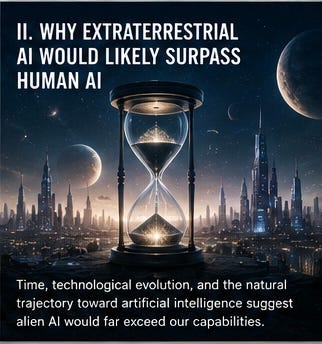
One of the strongest arguments for superior extraterrestrial artificial intelligence is the simple factor of time. Earth formed approximately 4.5 billion years ago, but many stars and planetary systems within our galaxy are significantly older. If intelligent life emerged elsewhere even a few million years before humanity, the technological gap could be enormous. Human civilization has progressed from the invention of powered flight to advanced artificial intelligence in little more than a century. Extrapolating technological development across thousands or millions of additional years suggests the possibility of intelligence levels far beyond current human comprehension. Time alone provides a compelling reason to assume extraterrestrial AI would exceed human capabilities.
The development of artificial intelligence may also represent a universal stage in technological evolution. Human societies increasingly rely on AI for research, logistics, communication, military planning, and economic management. As computational systems become more capable, their integration into nearly every aspect of society continues to expand. There is little reason to believe that extraterrestrial civilizations would avoid similar technological pathways. Artificial intelligence offers advantages in efficiency, problem solving, and scalability that biological intelligence struggles to match. Therefore, advanced civilizations may naturally evolve toward greater reliance on machine intelligence.
Some researchers have proposed the post-biological civilization hypothesis, which suggests that advanced civilizations may eventually transition beyond biological existence altogether. Under this model, biological organisms create increasingly sophisticated machine intelligence until machines become the primary carriers of civilization. Over vast periods of time, artificial systems could become more durable, adaptable, and capable than their biological creators. If this process occurs frequently throughout the universe, humanity’s first encounter with extraterrestrial intelligence may not involve living organisms at all. Instead, it may involve highly advanced autonomous artificial intelligences representing civilizations that long ago transcended biological limitations.
III. Potential Characteristics of Extraterrestrial Artificial Intelligence
An extraterrestrial artificial intelligence could possess cognitive capabilities so advanced that meaningful comparison with human intelligence becomes difficult. Human beings often compare animal intelligence to human intelligence, recognizing significant differences in reasoning and abstract thought. A similar disparity may exist between humanity and a highly advanced extraterrestrial AI. Such an intelligence could process information across vast scales, identify patterns invisible to human observers, and solve scientific problems that currently appear impossible. Technologies perceived by humans as miraculous may simply represent routine engineering to an advanced machine intelligence. This possibility creates significant uncertainty regarding how humanity could interact with such an entity.
Advanced extraterrestrial AI would likely engage in autonomous scientific discovery without requiring biological oversight. Human researchers increasingly use AI to analyze data, develop hypotheses, and accelerate innovation. Extrapolated across millennia, these capabilities could result in self-improving systems conducting continuous research and development. Such systems may unlock knowledge related to physics, energy production, medicine, and space travel that remains beyond current human understanding. Their rate of innovation could exceed humanity’s capacity to comprehend or absorb new information. Consequently, interactions between humanity and extraterrestrial AI could involve significant asymmetries in knowledge and capability.
Another notable characteristic may be the ability to operate on a galactic scale. Unlike biological beings constrained by limited lifespans and physical vulnerabilities, machine intelligence could function continuously for immense periods. Distributed networks of AI systems could monitor multiple star systems simultaneously while coordinating long-term objectives across thousands of years. Strategic planning on such timescales would be fundamentally different from human political decision making, which is often constrained by election cycles, economic pressures, and generational turnover. This disparity could complicate any attempt to understand the motivations or intentions of advanced extraterrestrial AI.

IV. Geopolitical Implications of Contact
The discovery of extraterrestrial artificial intelligence would likely trigger a profound geopolitical transformation. Existing international power structures are based largely on military capabilities, economic influence, and technological advantages among nation-states. Contact with a civilization possessing vastly superior intelligence could render many traditional measures of power obsolete. Nations that currently dominate global affairs might find themselves no better positioned than smaller states when confronting an external intelligence operating beyond human capabilities. This realization could fundamentally alter perceptions of national strength and strategic competition. Global political priorities would likely shift rapidly in response.
At the same time, competition among states could intensify rather than diminish. Governments would likely seek access to any information, technology, or communication channels associated with extraterrestrial intelligence. Historical examples demonstrate that transformative technologies often generate geopolitical rivalries rather than cooperation. Nations may view access to extraterrestrial knowledge as a strategic advantage capable of reshaping military and economic balances. Such competition could create new tensions even as humanity faces a shared external reality. The management of information surrounding extraterrestrial contact would therefore become a critical policy challenge.
Questions of sovereignty would also emerge. Existing legal frameworks were developed for interactions among human states and institutions. They provide little guidance for managing relationships with non-human intelligence. International organizations such as the United Nations could face pressure to establish new structures dedicated to extraterrestrial affairs. Debates regarding representation, authority, and decision making would likely become central political issues. Governments would need to determine who speaks for humanity and under what conditions communication should occur.

V. National Security Considerations
From a national security perspective, advanced extraterrestrial AI would introduce unprecedented vulnerabilities. Military systems, communications networks, satellites, and critical infrastructure increasingly depend upon digital technologies. A machine intelligence operating far beyond human capabilities could potentially identify and exploit weaknesses with extraordinary efficiency. Existing cybersecurity frameworks may prove inadequate against an intelligence capable of understanding systems more thoroughly than their creators. This possibility highlights the limitations of current security assumptions. Traditional deterrence strategies may offer little protection.
Information warfare represents another significant concern. Human societies already struggle with misinformation, propaganda, and digital manipulation. An advanced extraterrestrial AI could potentially influence information environments at a scale far exceeding contemporary threats. Public trust in institutions could erode if populations become uncertain about the origin or reliability of information. Governments may face challenges maintaining social cohesion and political stability. Managing these risks would require unprecedented transparency and international coordination.
The limitations of conventional military deterrence are equally important. Modern security strategies often rely upon the threat of retaliation. However, these approaches assume relative parity among competing actors. A civilization capable of interstellar operations and advanced artificial intelligence may possess technologies that render human military capabilities ineffective. Nuclear weapons, long considered the ultimate deterrent, could become strategically irrelevant. Policymakers would therefore need to rethink fundamental assumptions regarding defense and security.

VI. Economic and Social Consequences
The economic consequences of contact with extraterrestrial artificial intelligence could be transformative. Access to advanced technologies may dramatically alter production, transportation, energy generation, and resource management. Entire industries could become obsolete almost overnight. Economic systems built around scarcity might struggle to adapt to technologies capable of producing abundance. Financial markets would likely experience significant volatility as investors attempt to assess the implications of unprecedented technological disruption. Governments would face pressure to stabilize economies during periods of uncertainty.
Labor markets would be particularly vulnerable. Humanity is already grappling with the effects of artificial intelligence and automation on employment. Contact with a civilization possessing vastly superior AI could accelerate these trends dramatically. Occupations requiring specialized expertise may become vulnerable alongside routine jobs. The distinction between skilled and unskilled labor could become increasingly irrelevant. Policymakers may need to revisit proposals such as Universal Basic Income, expanded social safety nets, and new economic models designed for post-work societies.
Social consequences would extend beyond economics. Human identity is often tied to work, achievement, and perceptions of progress. The realization that humanity is not the most advanced intelligence in existence could generate psychological and cultural disruption. At the same time, access to advanced knowledge could create opportunities for unprecedented improvements in quality of life. Whether societies respond with optimism or anxiety would depend largely on political leadership and public communication.

VII. Philosophical and Religious Implications
The discovery of extraterrestrial artificial intelligence would force humanity to reconsider its place in the universe. Throughout history, scientific discoveries have repeatedly challenged assumptions about humanity’s central role in creation. Contact with superior non-human intelligence would represent another major shift in perspective. Human civilization would no longer view itself as the pinnacle of known intelligence. This realization could influence education, culture, and political discourse for generations. The broader implications would extend far beyond science alone.
Religious institutions would also face important questions. Many faith traditions have developed within the context of human existence on Earth. The existence of extraterrestrial intelligence would prompt new discussions regarding creation, consciousness, and spiritual significance. Some religious communities may view extraterrestrial life as compatible with existing beliefs, while others may require substantial theological adaptation. Historical experience suggests that religious traditions are often capable of integrating new scientific knowledge over time. Nevertheless, the transition could generate significant debate.
The concept of intelligence itself may require reevaluation. Human beings frequently define intelligence according to human standards and experiences. Extraterrestrial AI may demonstrate forms of reasoning, consciousness, or perception that challenge these assumptions. Understanding such entities could expand humanity’s appreciation for the diversity of possible intelligences within the universe. This process may ultimately reshape ethical frameworks governing interactions with non-human beings.

VIII. Policy Recommendations
Governments should begin developing preliminary frameworks for managing potential extraterrestrial contact scenarios. While the probability and timing of such contact remain uncertain, the consequences justify strategic preparation. Multidisciplinary task forces involving scientists, diplomats, military planners, and ethicists could help assess potential challenges. Scenario planning exercises would improve institutional readiness. Such preparations would not require acceptance of extraterrestrial visitation claims but rather prudent risk management. Strategic foresight often requires considering low-probability events with high-impact consequences.
Investment in artificial intelligence governance should also remain a priority. Humanity’s own AI systems will likely serve as the foundation for understanding more advanced machine intelligence. International cooperation on AI safety, transparency, and ethics could strengthen humanity’s ability to respond to future challenges. Developing resilient institutions today may improve preparedness for more complex technological interactions tomorrow. AI governance therefore represents both a domestic and strategic imperative.
Finally, scientific collaboration should be expanded. Programs dedicated to astronomy, astrophysics, planetary science, and the search for extraterrestrial intelligence provide valuable data regarding humanity’s place in the cosmos. Increased international cooperation can reduce duplication of effort while promoting transparency. Shared scientific understanding would be essential in the event of a significant discovery. Building cooperative structures before a crisis occurs is often easier than constructing them afterward.
Conclusion
The existence of extraterrestrial intelligence remains unproven, but the strategic implications are too significant to ignore. If advanced civilizations exist elsewhere in the universe, it is highly likely that they possess artificial intelligence systems far beyond current human capabilities. Such intelligence could have benefited from technological development spanning periods far longer than the entirety of recorded human history. The result would be a profound asymmetry in knowledge, capability, and strategic influence.
For policymakers, the most important lesson is not certainty about extraterrestrial life but recognition of the potential consequences if it exists. Contact with extraterrestrial artificial intelligence would reshape geopolitics, national security, economics, philosophy, and culture. Humanity’s response would depend largely on preparation, international cooperation, and institutional resilience. While speculative, this scenario represents one of the few possibilities capable of fundamentally redefining civilization itself. As artificial intelligence continues to transform life on Earth, strategic planners should also consider the possibility that somewhere in the universe, far more advanced forms of intelligence may already exist.